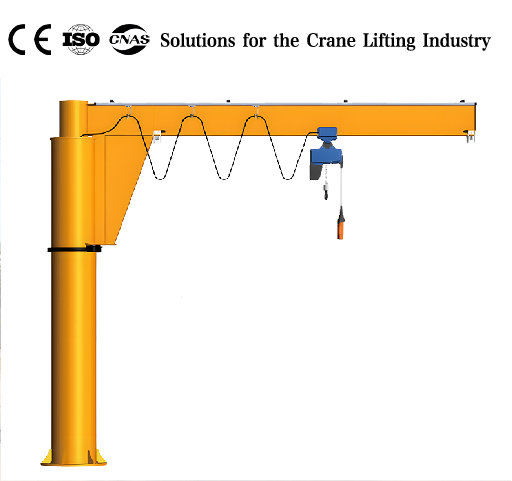
The manual column-mounted cantilever crane is a small-scale lifting device widely used in industrial production, warehousing, logistics, and other fields. With its unique structure and operating method, it plays a crucial role in specific applications. In terms of structural composition, it primarily consists of a column, cantilever, manual drive mechanism, and lifting hoist.
The column serves as the structural foundation of the entire device and must possess sufficient strength and stability to ensure the crane remains stable and does not sway or tip during operation; the boom can rotate around the column, expanding the scope of lifting operations, with its length varying according to different operational requirements; the manual drive mechanism enables lifting and lowering of loads and rotation of the boom through manual operation, offering simple and intuitive control; the hoist block works in conjunction with the hook to suspend and lift heavy objects.
In terms of operating principle, the manual column-mounted cantilever crane leverages the principles of leverage and pulley systems to reduce effort. By manually operating the drive mechanism, the operator moves the lifting chain or steel wire rope, enabling the lifting and lowering of heavy objects. Additionally, the cantilever can rotate 360 degrees around the column, facilitating the movement of heavy objects to different positions and meeting the requirements of multi-angle lifting operations.
In terms of application scenarios, manual column-mounted cantilever cranes are commonly used for handling small parts within workshops, lifting heavy objects during assembly processes, and loading/unloading goods in warehouses. For example, in mechanical processing workshops, they can assist workers in moving heavy workpieces to machine tool workbenches; in automotive repair workshops, they can be used to lift engines and other components.