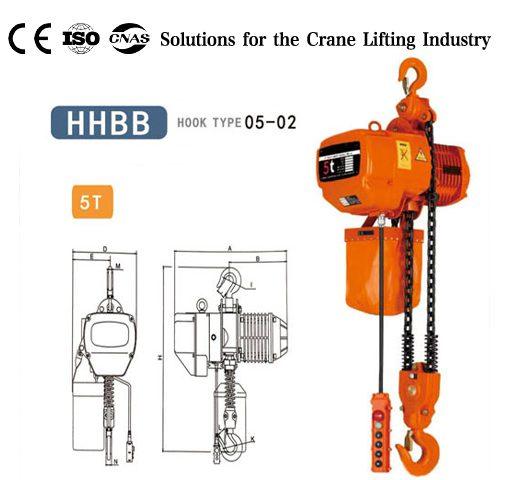
Electric chain hoists convert electrical energy into mechanical lifting power via motors, gearboxes, and high-strength chains.
Core components include the motor, load chain, gearbox, brake system, and limit switches for safe operation.
Applications span manufacturing, construction, warehousing, automotive, and entertainment industries.
Advantages over manual hoists include greater efficiency, higher load capacities, and enhanced safety features.
Selection depends on factors like load capacity, duty cycle, power supply, and environmental conditions.
1 Understanding Electric Chain Hoists
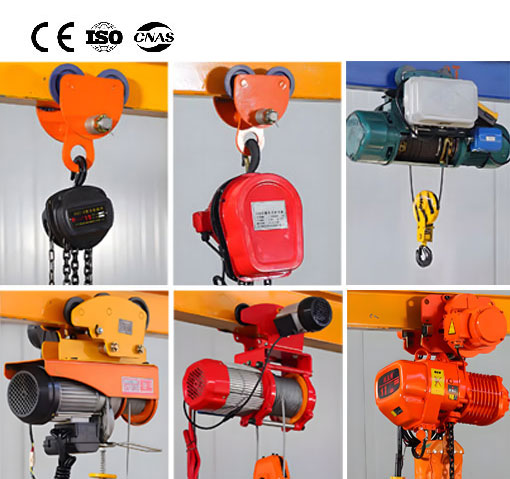
An electric chain hoist is a motorized lifting device that uses an industrial-grade chain to vertically raise and lower heavy loads with precision. Unlike manual hoists requiring physical effort, these systems convert electrical energy into mechanical action through an integrated motor, making them indispensable for modern industrial operations. Their design balances power with control, enabling workers to handle multi-ton loads with minimal physical strain while maintaining millimeter-level accuracy in positioning .
The fundamental distinction between electric chain hoists and alternatives like wire rope hoists lies in their lifting medium and mechanism. While wire rope hoists wind cables onto drums (suited for long lifts and heavy capacities), electric chain hoists use sprockets to guide hardened steel chains. This provides true vertical lift paths, making them ideal for precision tasks in confined spaces. Their chains—often heat-treated alloy steel—offer superior wear resistance and compactness compared to wire ropes, though with slightly lower maximum capacities .
2 Core Components and Their Functions
Electric chain hoists integrate several critical components that ensure reliable and safe operation:
Electric Motor: The powerhouse driving the hoist, converting electricity into rotational force. Motors are typically encased in aluminum housings with cooling fans to prevent overheating during prolonged use .
Lifting Chain: Constructed from hardened alloy steel (e.g., Grade 80 or 100), these chains feature specialized profiles for increased strength. Some advanced models use profile steel chains offering 15% higher capacity than round chains at identical diameters .
Gearbox: Reduces the motor’s high-speed rotation into high-torque, low-speed output. This enables the hoist to lift heavy loads efficiently without stalling .
Brake System: Automatically engages when power stops, preventing load drops. Electromagnetic or spring-loaded brakes are common, often backed by slip clutches to protect against overload .
Control Pendant: An ergonomic, low-voltage (24V–48V) handheld controller with push buttons for lifting/lowering. Includes emergency-stop functions and strain relief for operator safety .
Limit Switches: Automatically halt the hoist at preset upper/lower positions, preventing overtravel and chain damage .
Table: Key Components of Electric Chain Hoists
| Component | Function | Technical Features |
|---|---|---|
| Motor | Converts electrical energy to mechanical rotation | Aluminum housing, integrated cooling fan |
| Lifting Chain | Bears the load during lifting | Case-hardened steel, corrosion-resistant coatings |
| Gearbox | Increases torque while reducing motor speed | Polygonal shaft connections for easy maintenance |
| Brake System | Secures loads when hoist is idle | Spring-loaded or electromagnetic, fail-safe |
| Control Pendant | Allows operator to direct hoist movements | IP65-rated, 42V low voltage, emergency stop |
| Limit Switches | Prevents over-travel at maximum/minimum heights | Geared or proximity-based sensors |
3 How Electric Chain Hoists Work: The Lifting Process
The operation sequence of an electric chain hoist exemplifies elegant engineering simplicity:
Activation: The operator presses the “lift” button on the control pendant, sending a low-voltage signal to the motor .
Power Conversion: The motor converts electrical energy into high-speed rotational force .
Torque Adjustment: The motor’s output enters the gearbox, where gears reduce speed while multiplying torque. For example, a 1440 RPM motor might be reduced to 20 RPM—sufficient to lift several tons .
Chain Movement: The gearbox’s output shaft rotates a load sprocket, which engages with and pulls the chain upward. The chain collects neatly into a steel or fabric chain container to prevent tangling .
Load Control: Precision dual-speed models (e.g., 6.9 m/min high speed and 2.3 m/min low speed) allow fine positioning during final load placement .
Safety Assurance: Brakes engage instantly upon button release, while limit switches halt operations if the hook approaches unsafe heights .
Diagram Suggestion: Consider adding a visual flowchart showing energy conversion from electricity → motor rotation → gear reduction → chain movement → vertical lift.
4 Evolution of Lifting Technology
The journey from rudimentary lifting methods to electric chain hoists reflects centuries of innovation:
Ancient Era: Early civilizations used wooden pulleys and ropes for monumental projects like Egypt’s pyramids. These required massive human labor and offered minimal control .
19th Century: Manual chain hoists (“chain blocks”) emerged, using geared mechanisms to multiply pulling force. Though revolutionary, they still demanded strenuous effort .
Early 20th Century: The first electric hoists combined motors with chain mechanisms. Brands like LOADMATE pioneered robust designs for factories, introducing features like thermal protection and geared limit switches .
Late 20th Century: Alloy steel chains replaced lower-grade materials, while modular designs simplified maintenance. Polygonal shaft connections (e.g., GIS’s GP series) enabled faster disassembly .
21st Century: Smart controls, IoT sensors, and energy-efficient motors dominate. For example, LOADMATE’s hoists now integrate friction clutches and inverter technology for smoother starts/stops .
5 Industrial Applications and Use Cases
Electric chain hoists excel across diverse sectors due to their versatility and precision:
Manufacturing: Assembly lines use them to position machinery components with sub-millimeter accuracy. Their ability to handle 500–5,000 kg loads makes them ideal for automotive engine installations .
Construction: Steel beams, precast concrete panels, and scaffolding systems are routinely lifted using electric chain hoists mounted on gantries or trolleys 19.
Warehousing/Logistics: Electric hoists load/unload goods in distribution centers, particularly where overhead cranes maximize floor space. Their compact profiles suit low-clearance buildings .
Entertainment: Stage rigging for concerts and theaters relies on whisper-quiet hoists to suspend lighting, screens, and sound equipment safely .
Specialized Environments: IP65-rated hoists (dust/water resistant) operate in agri-food processing plants, while heat-resistant chains handle temps up to 300°C in foundries .
Table: Electric Chain Hoist Applications by Industry
| Industry | Typical Use Cases | Load Range | Special Requirements |
|---|---|---|---|
| Manufacturing | Machinery assembly, part transfer | 0.5–10 tons | Precision positioning, dual speeds |
| Construction | Steel erection, material handling | 1–32 tons | Outdoor durability, trolley mounting |
| Warehousing | Loading docks, high-bay storage | 0.5–5 tons | Low headroom design, frequent use |
| Automotive | Engine/transmission installation | 1–5 tons | Cleanroom operation, ergonomic controls |
| Entertainment | Stage lighting, screen rigging | 0.5–2 tons | Silent operation, smooth acceleration |
6 Advantages of Electric Chain Hoists
Enhanced Efficiency: Tasks requiring hours of manual labor are completed in minutes. For example, a 3-ton electric hoist lifts at 8.8 m/min—20× faster than manual alternatives .
Superior Safety: Integrated brakes hold loads statically, while limit switches prevent over-travel. Modern pendants include emergency-stop buttons and slip clutches to prevent overloads .
Ergonomic Design: Operators control heavy loads via lightweight pendants, reducing musculoskeletal injuries. FineWork’s models even feature 360° rotating hooks to prevent chain twisting .
Duty Cycle Flexibility: While entry-level hoists manage 25% duty cycles (15 minutes/hour), industrial-grade units like GIS’s GP series support continuous operation in three-shift environments .
Cost-Effectiveness: Reduced labor requirements and faster cycle times lower operational costs. KITO notes maintenance costs are 30% lower than wire rope hoists due to simpler chain systems .
7 Technical Specifications and Configurations
Electric chain hoists vary by capacity, speed, and power:
Load Capacities: Range from light-duty (320 kg) to heavy-industrial (32 tons). The GIS GP2500, for example, handles 4–8 tons .
Lifting Speeds: Single-speed models average 3–9 m/min, while dual-speed units offer precision modes as low as 0.8 m/min. Capacities above 5 tons typically prioritize torque over speed .
Power Requirements: Standard models use 115V, 230V, or 400V three-phase power. Low-voltage controls (24V–48V) ensure operator safety .
Environmental Ratings: IP65-classified hoists resist dust and water jets, making them suitable for washdown environments or outdoor use .
Specialized Features: Wind-resistant trolleys for bridge cranes, explosion-proof motors for chemical plants, and high-temperature chains for foundries .
8 Safety, Maintenance, and Operational Best Practices
Safety Mechanisms
Brakes: Spring-loaded or electromagnetic systems engage automatically during power loss.
Overload Protection: Slipping clutches disengage gears if loads exceed rated capacity .
Hook Latches: Forged safety latches prevent accidental disengagement .
Voltage Safety: 42V control pendants minimize electrocution risks .
Maintenance Guidelines
Daily: Inspect chains for wear, cracks, or deformation; test limit switches and brakes.
Monthly: Lubricate chains with manufacturer-approved oils; check gearbox oil levels.
Annually: Verify motor insulation resistance (F-class standard); recalibrate limit switches .
5-Year: Replace load chains regardless of visible wear; overhaul gearbox and brake assemblies.
Operational Tips
Never exceed rated capacity, even briefly.
Ensure angular forces from slings don’t create sideways pulls exceeding 15° .
Use trolleys for lateral movement instead of swinging loads manually.
9 Selection Guide: Choosing the Right Hoist
Selecting an electric chain hoist requires evaluating several parameters:
Load Capacity/Lift Height: Add 10–15% to your maximum load weight for safety margins. For heights >15m, wire rope hoists may be better .
Power Supply: Confirm voltage (115V, 230V, 400V) and phase (single/three-phase). Sites without 230V+ power may require manual or pneumatic hoists .
Duty Cycle: Frequent users (e.g., warehouses) need 40%+ duty cycle models; intermittent users (e.g., workshops) can opt for 25% units .
Environment: Choose IP65-rated hoists for damp/dusty areas, heat-treated chains (300°C+) for foundries, and explosion-proof motors for flammable atmospheres .
Mounting: Low-clearance buildings benefit from compact “low-headroom” designs. Trolley-mounted hoists add mobility but require I-beam supports .
10 Comparison with Alternatives
Electric vs. Manual Chain Hoists: Electric hoists are 500% faster and reduce worker fatigue but cost 2–3× more. Manual hoists suit low-budget, low-frequency, or power-scarce sites .
Electric Chain vs. Wire Rope Hoists: Chain hoists offer truer vertical lifts and better precision, while wire rope hoists excel for capacities >10 tons and lifts >30m .
11 Future Trends and Innovations
Smart Hoists: IoT-enabled sensors monitor chain wear, motor temperature, and overloads in real-time, predicting failures before they occur .
AI Integration: Machine learning algorithms optimize lift paths and speed based on load dynamics, reducing swing and energy use .
Eco-Designs: Regenerative drives feed braking energy back into power grids, cutting electricity costs by 15–20% .
Advanced Materials: Carbon-fiber-reinforced chains promise 50% weight reduction with higher tensile strength .
12 Conclusion: The Unstoppable Ascent
Electric chain hoists have redefined material handling, merging raw power with surgical precision. From their humble beginnings as manual chain blocks to today’s IoT-ready smart lifters, they embody engineering evolution in pursuit of efficiency and safety. As industries increasingly prioritize automation, sustainability, and operator well-being, these hoists will continue evolving—driven by AI, advanced materials, and ergonomic design. For businesses seeking to optimize lifting operations, understanding their mechanics, benefits, and selection criteria isn’t just advantageous—it’s essential for staying competitive in a weighty world.