Category: 未分类

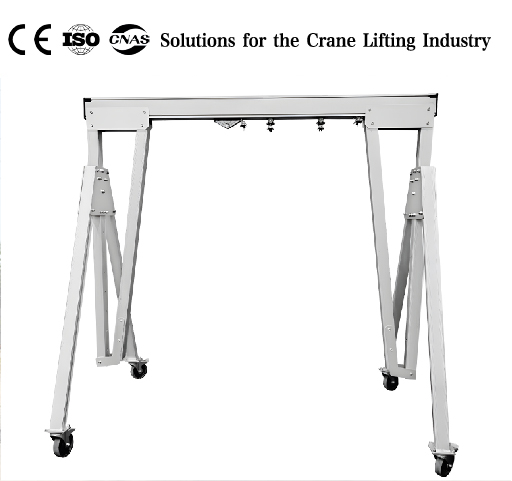
  • Aluminum alloy small gantry

    Aluminum alloy small gantry

    The aluminum alloy small gantry crane is a lightweight lifting device made from high-strength aluminum alloy as its core material. With its “lightweight + portable” characteristics, it plays a significant role in small-scale lifting applications. Its structure is simple, typically consisting of two aluminum alloy columns, a crossbeam, and swivel casters at the bottom. The overall weight is only 1/3 to 1/2 of that of a steel-made small gantry crane of the same specification (e.g., approximately 50-80 kg for a 1-ton model). It can be manually disassembled and assembled quickly, and can be transported by a single person, making it suitable for narrow spaces such as workshop corners or laboratories.

    In terms of performance, the lifting capacity ranges from 0.5 to 3 tons, the span covers 1.5 to 4 meters, the lifting height is 1.2 to 3 meters, and the work class is typically A2 to A3. It is suitable for light-load, low-frequency cargo handling (such as small equipment, molds, and components). The lifting mechanism is typically equipped with a manual hoist or small electric hoist (lifting speed: 3–8 m/min), and the bottom swivel casters feature a braking function, ensuring flexible mobility and reliable stability.

    They are widely applicable in various scenarios, including electronics factories, food processing plants, laboratories, and maintenance facilities where equipment weight and cleanliness are critical. They can replace manual handling for labor-saving operations while avoiding the drawbacks of steel equipment, such as rusting and heavy weight, making them a flexible and practical solution in the lightweight lifting field.
  • Double-girder tire crane

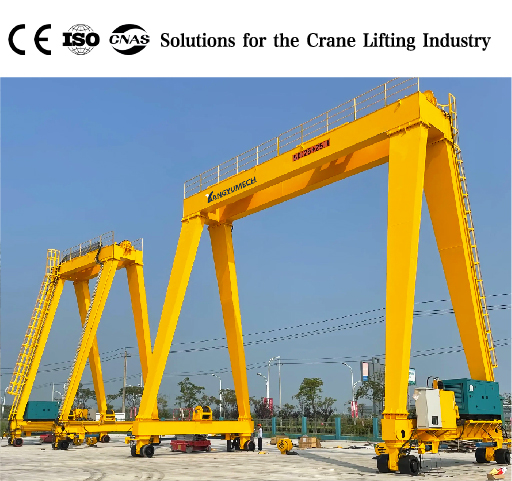
    Double-girder tire crane

    Dual main beam load-bearing reinforcement: Utilizing two parallel box-type or truss-type main beams connected by cross beams to form a rigid frame, the load-bearing capacity is increased by over 50% compared to single-beam tire-mounted cranes, accommodating lifting requirements from 10 to 50 tons (with some custom models reaching 100 tons)

    The span range is extended to 12-30m, making it suitable for lifting extra-long and extra-wide components such as steel structures and precast panels. Tire-mounted mobility: Equipped with multiple sets of pneumatic tires (typically 4-8 wheels), no fixed tracks are required, allowing free movement on hardened surfaces (concrete, asphalt). The minimum turning radius is approximately 5-8m, enabling rapid relocation between work sites (e.g., from a workshop to a storage yard).

    Travel speeds reach 10-20 km/h, significantly outperforming the mobility efficiency of track-mounted cranes. Stability system upgrade: Standard-equipped with retractable hydraulic outriggers, which, when deployed during operation, provide a support area 30%-50% larger than single-beam models. Combined with counterweight design, ground pressure can be reduced to 0.1-0.2 MPa, enabling stable operation on non-hardened surfaces (such as compacted soil). The anti-overturning performance meets the GB/T 3811-2008 heavy-duty standard.

  • Upper package lower fancy gantry crane

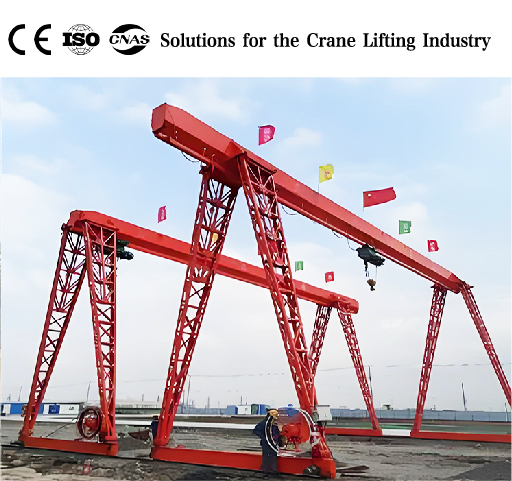
    Upper package lower fancy gantry crane

    Upper “enclosed” structure: The main beam and trolley running area adopt a closed box-type structure (“enclosed”), formed by welding steel plates into a closed cross-section. This design enhances the main beam’s torsional stiffness and overall stability, enabling it to withstand significant vertical loads and horizontal forces, making it suitable for high-precision operation of the hoisting mechanism. Additionally, the enclosed structure provides a more stable track foundation for trolley operation, reducing vibration and swaying, thereby ensuring safety during heavy-load or precision lifting operations.

    Lower “lattice” structure: The legs and lower support sections adopt a lattice-type (“lattice”) design, formed by connecting structural steel (such as angle steel, channel steel) via bolts or welding to create a perforated truss structure. This structure significantly reduces the equipment’s self-weight, minimizes pressure on the foundation, and offers excellent ventilation to reduce wind resistance, making it particularly suitable for outdoor, windy environments (such as ports and cargo yards).

  • What are the main components of a crane

    1. Boom:
    – The boom is the main supporting structure of the crane, used for suspending and moving heavy loads.
    – It can be fixed or telescopic to accommodate various work requirements.

    2. Hook:
    – The hook is the part that connects the crane to the object being lifted.
    – It usually has a safety mechanism to ensure that the load does not accidentally fall off during lifting.

    3.Wire Rope:
    – The wire rope is used to connect the hook to the crane’s hoist system, transferring the lifting force.
    – It requires regular inspection and maintenance to prevent wear or breakage.

    4. Hoist System:
    – The hoist system includes an electric motor and a reducer, used to control the winding and unwinding of the wire rope, thereby raising or lowering the load.

    5. Sheaves or Pulleys:
    – The pulley system assists in lifting the load by changing the direction of the force and increasing the force multiplier.

    What are the main components of a crane

    6. Revolving Mechanism:
    – The revolving mechanism allows the crane’s boom to rotate horizontally, expanding the working range.

    7. Traveling Mechanism:
    – For mobile cranes, the traveling mechanism includes wheels or tracks, allowing the crane to move on the ground.

    8. Cab or Operator’s Cabin:
    – The cab provides an environment for the operator to control the crane.
    – It is usually equipped with various control devices and safety equipment.

    9. Hydraulic System:
    – For hydraulic cranes, the hydraulic system is used to provide power to perform actions such as lifting, lowering, and extending.

    10. Electrical System:
    – The electrical system provides power for electric cranes, including cables, control panels, and various sensors.

    11. Safety Devices:
    – Includes overload limiters, limit switches, emergency stop buttons, etc., to ensure safe operation.

    12.Counterweights:
    – Some types of cranes, especially mobile cranes, use counterweights to increase stability and prevent the crane from tipping over when lifting heavy loads.

    These components work together to ensure that the crane can safely and efficiently perform its task of lifting and moving heavy objects.