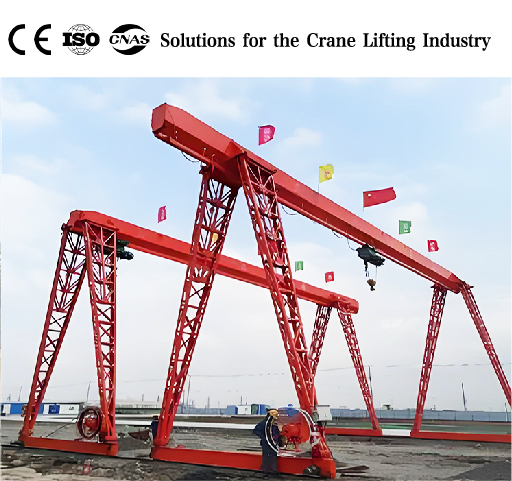
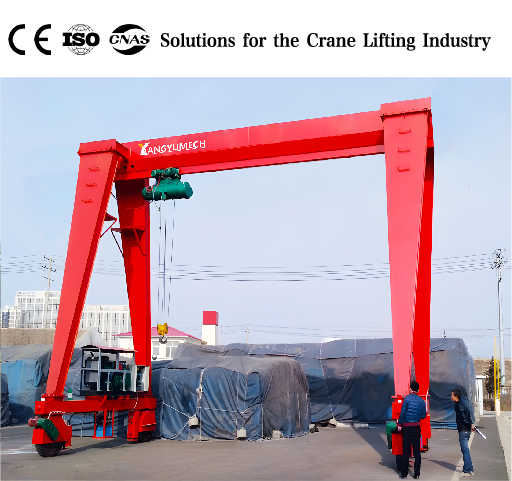
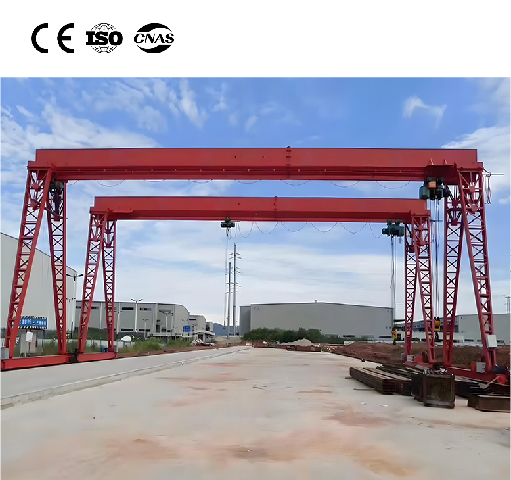
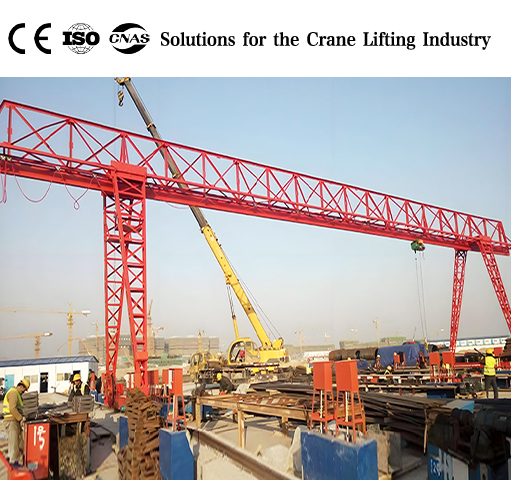
In industrial spaces like large-scale warehouses, manufacturing plants with parallel production lines, and logistics hubs with dual-sided loading docks, lifting tasks often demand “symmetric coverage”—for instance, transferring materials between two adjacent assembly lines, loading/unloading trucks on both sides of a central aisle, or hoisting goods to storage racks flanking the crane’s path. Traditional gantry cranes struggle to meet this need: single-side overhang models can only reach one side, leading to inefficient repositioning, while no-overhang models are confined to the area between their legs. This is where the Yangyu Bilateral overhang Single girder gantry crane emerges as a game-changer. Engineered with identical external overhangs (1-3 meters per side) on both ends of the main girder, this crane delivers balanced lifting performance (rated capacity 1-12 tons) and seamless adaptation to symmetric workspaces. Whether you’re a plant manager coordinating dual-line production or a warehouse supervisor optimizing two-sided loading, this guide will detail everything you need to know about this specialized crane: its design highlights, core advantages, real-world applications, selection strategies, and why it outperforms generic symmetric-lifting solutions.
What Is the Yangyu Bilateral overhang Single girder gantry crane?
To understand the unique value of this crane, let’s start with its definition, structural characteristics, and how it differs from standard single girder gantry cranes:
1. Core Design: Symmetric Bilateral Overhang for Balanced Coverage
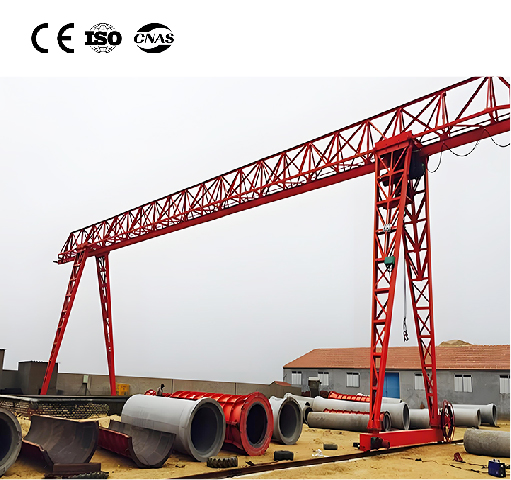
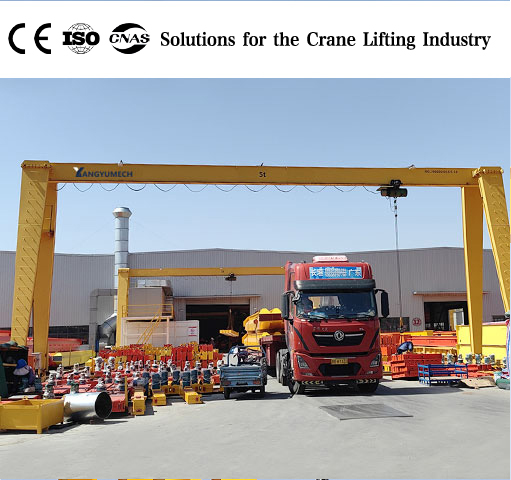
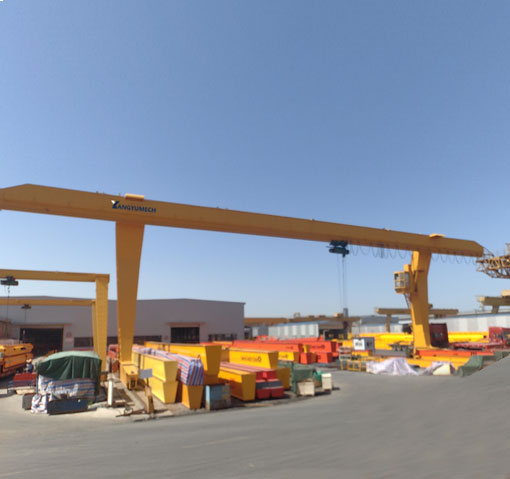
The Yangyu Bilateral overhang Single girder gantry crane features a single main girder (crafted from high-strength Q345 box-section steel) supported by two heavy-duty end carriages (legs). Unlike single-side overhang models, it extends identical overhang beams from both sides of the main girder—each overhang (customizable from 1.5m to 3m) projects beyond the outer edge of the corresponding leg, forming a “symmetric working range” that covers both the inner area (between the legs) and the two outer zones (beyond each overhang).
Yangyu optimizes the bilateral overhang structure with two key engineering enhancements:
- Symmetric Stress Distribution: Reinforced steel plates (14-18mm thick) are welded at the junction of the main girder and each overhang beam, ensuring even load transfer—even when lifting full-capacity loads on both overhangs simultaneously, preventing structural deformation.
- Continuous Trolley Rail: A patented Yangyu YR-series anti-derail trolley rail runs seamlessly along the main girder and both overhang beams, allowing the lifting hoist to move smoothly between inner and outer workspaces without jolts or derailment risks.
2. Key Components & Yangyu-Exclusive Upgrades
Every Yangyu bilateral overhang crane integrates durable components and brand-specific innovations to ensure long-term reliability:
- Main Girder: Adopts box-section steel (instead of standard I-steel), which boosts rigidity by 35% compared to single-side overhang models—minimizing deflection when lifting heavy loads on both overhangs.
- Bilateral Overhang Beams: Heat-treated and galvanized for corrosion resistance, with built-in vibration dampers (Yangyu patent) to reduce load sway during outdoor or high-wind operations.
- Electric Hoist: Equipped with Yangyu’s YH-Pro series electric hoist (220V/380V), featuring dual-speed control (10m/min for fast lifting, 2m/min for precise positioning) and IP55 protection—suitable for dusty, humid, or semi-outdoor environments.
- Control System: A wireless remote (150m operating range) with dual LCD displays (showing load weight and hoist position for each overhang) and a “symmetric mode”—this mode synchronizes hoist movement on both sides, critical for lifting long materials (e.g., 6m steel beams) that require balanced support.
- Safety Systems: Overload protection (auto-stops at 110% of rated capacity), bilateral limit switches (prevent the hoist from exceeding overhang ends), and a wind-speed sensor (auto-locks the hoist if wind speed exceeds 10 m/s). All safety features comply with international standards such as ISO 4301, CE, and OSHA.
Why Choose the Yangyu Bilateral overhang Single girder gantry crane?
Yangyu’s bilateral overhang design isn’t just a “two-sided extension” of single-side models—it solves pain points that generic symmetric cranes can’t address. Here are its standout advantages:
1. Perfect for Symmetric & Dual-Side Workspaces
For sites where lifting needs are evenly distributed on both sides of the crane’s path, this model eliminates the inefficiency of using two single-side overhang cranes. Typical scenarios include:
- Dual-Loading Warehouses: A logistics hub with loading docks on both sides of a 15m-wide central aisle—each overhang reaches directly into truck beds (up to 3m from the aisle), cutting truck turnaround time by 50% compared to alternating between two single-side cranes.
- Parallel Production Lines: An automotive factory with two assembly lines flanking the crane’s path—the left overhang lifts parts from a storage area to Line A, while the right overhang moves finished components from Line B to shipping, no crane repositioning required.
Tests show that Yangyu’s bilateral overhang crane increases “dual-side task efficiency” by 60% compared to using two single-side models, as it eliminates downtime from repositioning and setup.
2. Balanced High Load Capacity on Both Overhangs
Generic bilateral overhang cranes often have uneven load capacity on their two overhangs (e.g., a 5-ton model may only lift 3.5 tons on one side and 3 tons on the other). Thanks to Yangyu’s symmetric design and reinforced structure, 85-95% of the rated capacity is maintained on both overhangs:
- A 5-ton Yangyu crane can lift 4.7 tons on each 2m overhang.
- A 10-ton model handles 9 tons on each 2.5m overhang.
This balance is crucial for tasks like lifting long, heavy materials (e.g., 8-ton steel beams) that require support on both ends, preventing load tilting and costly damage.
3. Cost-Effective vs. Two Single-Side Overhang Cranes
Using two single-side overhang cranes to cover dual sides costs 40-50% more upfront than one Yangyu bilateral model. Additionally:
- Lower Installation Costs: One crane requires only one set of rails (or rubber tires) and one foundation, compared to two sets for dual single-side models. Installation takes 3-4 days (vs. 6-7 days for two cranes).
- Reduced Maintenance: With 50% fewer moving parts than two single-side cranes, annual maintenance costs are 500—40% less than maintaining two separate units.
4. Yangyu’s Durability & Weather Resistance
Yangyu subjects every bilateral overhang crane to rigorous testing to ensure industrial-grade performance:
- Dual-Overhang Load Test: 1,200 cycles of lifting 100% rated capacity on both overhangs simultaneously, with no structural deformation.
- Corrosion Test: 1,000 hours of salt-spray testing (simulating coastal environments) on galvanized overhang beams—no rust or wear detected.
Customers report an average service life of 13-16 years—4 years longer than generic bilateral overhang cranes—thanks to Yangyu’s high-quality steel and powder-coated finish (for indoor use) or galvanized + powder-coated combination (for outdoor use).
Real-World Applications of Yangyu Bilateral Overhang Cranes
Yangyu’s bilateral overhang model has proven its value across industries with symmetric lifting needs. Below are three detailed, industry-specific use cases:
Case 1: Dual-Side E-Commerce Warehouse (Netherlands)
A large e-commerce warehouse in Rotterdam handles 50+ delivery trucks daily, with loading docks on both sides of a 12m-wide central aisle. Using two single-side overhang cranes caused severe bottlenecks—trucks waited an average of 45 minutes for loading. After installing a 6-ton Yangyu bilateral overhang crane (2m overhangs on each side, 10m main span):
- Trucks on both sides were loaded simultaneously, cutting wait time to 15 minutes.
- The crane’s symmetric trolley movement reduced pallet damage by 70% (no more uneven lifting or jolts).
- Annual operational costs dropped by €30,000 (vs. maintaining two single-side cranes).
Case 2: Steel Fabrication Plant (China)
A Wuxi steel plant produces 10m-long steel beams (weighing 8 tons each) and needed to move them from a cutting line to two parallel welding lines. A single-side overhang crane required 20 minutes per beam (repositioning between lines); a Yangyu 10-ton bilateral overhang crane (2.5m overhangs) transformed operations:
- Beams were lifted from the cutting line and placed directly on either welding line in just 8 minutes.
- The crane’s vibration damper prevented beam warping (a $1,200 loss per damaged beam).
- Daily production increased from 30 beams to 55 beams (83% improvement).
Case 3: Agricultural Machinery Factory (U.S.)
An Iowa factory manufacturing tractors has two assembly lines and needed to move 5-ton engine blocks from a central warehouse to both lines. A no-overhang crane couldn’t reach the lines (2m from the warehouse edge); a Yangyu 7-ton bilateral overhang crane (2m overhangs) solved the problem:
- Engines were delivered to Line A via the left overhang and Line B via the right overhang, with zero downtime.
- The wireless remote’s symmetric mode ensured engines were placed within 2cm of the assembly fixture, reducing rework.
- Labor costs decreased by 25% (one operator handled both lines, vs. two operators before).
How to Select the Right Yangyu Bilateral overhang Single girder gantry crane?
To maximize your investment and ensure the crane fits your symmetric lifting needs, follow these 5 steps:
Step 1: Define Overhang Length & Load Requirements
- Bilateral Overhang Length: Measure the distance from each side of the crane’s path to the farthest lifting point (e.g., 2m from left leg to Line A = 2m left overhang; 2m from right leg to Line B = 2m right overhang). Yangyu offers 1.5m, 2m, 2.5m, and 3m overhangs—keep lengths identical for balanced tasks (custom unequal lengths are available for hybrid symmetric-asymmetric needs).
- Overhang Load Capacity: Calculate your heaviest load for either overhang (e.g., 4-ton pallets = choose a crane with ≥4.5-ton overhang capacity). Yangyu provides a “bilateral capacity chart” (e.g., 6-ton crane: 5.5t@2m overhangs, 5t@2.5m overhangs).
- Main Girder Span: Measure the distance between the two support points (e.g., warehouse walls, rail ends) for the crane’s main body—Yangyu offers spans from 6m to 22m.
Step 2: Match to Your Work Environment
- Indoor vs. Outdoor/Semi-Outdoor:
- Indoor (e.g., factories, warehouses): Standard model with IP54 hoist and powder-coated steel.
- Outdoor/Semi-Outdoor (e.g., ports, construction yards): Yangyu’s “All-Weather Package” (galvanized steel, IP65 hoist, rain cover for electrical components, and wind-speed sensor).
- Rail vs. Rubber-Tired:
- Fixed paths (e.g., between two production lines): Rail-mounted (Yangyu KR-Pro series rails, 22mm thick) with reinforced rail pads under both overhang legs to support heavy loads.
- Flexible paths (e.g., construction yards): Rubber-tired (battery-powered, 0-90° steering) with Yangyu’s anti-slip tires for uneven surfaces like gravel or concrete.
Step 3: Choose the Right Hoist & Controls
- Hoist Type:
- Electric Hoist (Yangyu YH-Pro series): Mandatory for dual-side tasks—supports continuous use (8+ lifts/hour) and symmetric mode. Choose 220V for small workshops, 380V for industrial sites.
- Manual Hoist (optional): Only for occasional, light loads (≤2 tons)—not recommended for bilateral tasks (lacks symmetric control and speed adjustment).
- Controls: Yangyu’s YC-Pro wireless remote is required (dual displays, emergency stop on both remote and crane). Avoid pendant controls, as they limit operator visibility of both overhangs.
Step 4: Verify Safety & Compliance
Ensure the crane meets regional standards to avoid accidents and legal risks:
- Global Markets: CE (Europe), OSHA (U.S.), ISO 4301 (international crane safety).
- China Market: GB/T 3811-2008 (crane design) and GB 6067.1-2010 (safety rules).
- Additional Safety: Add Yangyu’s “Bilateral Safety Kit” (includes load cell displays for both overhangs, anti-sway devices, and overhang beam stress sensors) for high-risk tasks (e.g., lifting 10+ ton loads or outdoor operations).
Step 5: Leverage Yangyu’s Customization & After-Sales Support
Yangyu specializes in tailored solutions for symmetric lifting—don’t settle for off-the-shelf models:
- Custom Overhangs: Need 3.5m overhangs? Yangyu can design them with reinforced steel (minor cost increase, no capacity loss).
- After-Sales Service: Opt for Yangyu’s “Global Care Plan”—24-hour repair support (available in 50+ countries), 2-year warranty on main girder/overhang beams, and 1-year warranty on the hoist.
- Site Assessment: Request a free on-site evaluation from Yangyu’s engineers—they’ll measure your workspace, calculate load needs, and recommend the optimal configuration.
Installation & Maintenance Tips for Yangyu Bilateral Overhang Cranes
Proper installation and regular maintenance are critical to ensuring symmetric performance and long service life. Follow Yangyu’s recommended guidelines:
Installation Best Practices (Yangyu-Certified)
- Foundation Preparation:
- Rail-mounted: Install Yangyu KR-Pro rails on a level concrete foundation (≥25cm thick) with laser alignment (error ≤0.8mm/m). Add 30cm-thick reinforced concrete pads under both overhang legs to support dual-side loads.
- Rubber-tired: Ensure ground slope ≤1.5° and bearing capacity ≥0.35MPa (use Yangyu’s ground test kit to verify).
- Symmetric Alignment:
- After mounting the main girder to the legs, use Yangyu’s dual-laser alignment tool to confirm both overhang beams are horizontal (error ≤0.5mm/m) and parallel to each other. Unbalanced overhangs cause hoist drift and load tilting.
- Dual-Overhang Test Run:
- No-Load Test: Run the hoist along the main girder and both overhangs 5 times—check for smooth movement and limit switch activation on both ends.
- Load Test: Lift 50% rated capacity on one overhang, then 50% on the other, then 100% on both simultaneously. Hold each test for 8 minutes and record deflection (must be ≤L/500, where L = overhang length).
Maintenance Schedule (Yangyu Guidelines)
Frequency | Tasks for Bilateral Overhang Cranes |
Weekly | 1. Clean rails on both overhang beams (use Yangyu’s rail brush).2. Inspect hoist cable for fraying (replace if 8+ broken wires/meter).3. Test both overhang limit switches and emergency stop. |
Monthly | 1. Lubricate trolley bearings on both overhangs with Yangyu YG-3 lithium grease.2. Tighten bolts at main girder-overhang junctions (torque to 450 N·m).3. Calibrate overload protection for both overhangs. |
Annually | 1. Hire Yangyu-certified technicians to inspect welds on both overhang beams.2. Replace overhang rails if wear exceeds 2mm (use Yangyu OEM parts only).3. Update remote control firmware and test symmetric mode. |
Common FAQs About Yangyu Bilateral Overhang Cranes
Q1: Can the two overhangs have different lengths?
A: Yes—Yangyu offers “asymmetric bilateral” models (e.g., 2m left overhang, 3m right overhang) for sites with uneven dual-side needs. Note: Capacity may vary slightly on longer overhangs (e.g., 5-ton crane: 4.7t@2m, 4.2t@3m).
Q2: Can the crane lift full capacity on both overhangs at the same time?
A: Yes—Yangyu’s reinforced main girder and symmetric design support simultaneous full-capacity lifting on both overhangs (e.g., 10-ton crane lifts 9t on left + 9t on right).
Q3: How does this crane compare to Yangyu’s single-side overhang model?
A: Choose bilateral if you need dual-side coverage (lower cost than two singles, higher efficiency). Choose single-side if you only need one-side access (lower upfront cost, less space). Bilateral models have 15% higher maintenance costs than single-side, but 40% lower than maintaining two single-side cranes.
Conclusion
The Yangyu Bilateral overhang Single girder gantry crane is the ultimate solution for symmetric and dual-side lifting tasks—combining balanced coverage, high load capacity, and Yangyu’s proven durability. Whether you’re managing two-sided loading docks, coordinating parallel production lines, or hoisting long materials that require dual support, this crane eliminates the inefficiencies of generic models. By following this guide to define your needs, select the right configuration, and leverage Yangyu’s expertise, you’ll invest in a crane that boosts productivity, cuts costs, and ensures safe, symmetric operation for years.
Ready to optimize your dual-side lifting operations? Contact Yangyu’s sales team today for a free quote and on-site assessment. With Yangyu’s bilateral overhang crane, you’ll turn symmetric lifting challenges into streamlined, high-efficiency workflows.