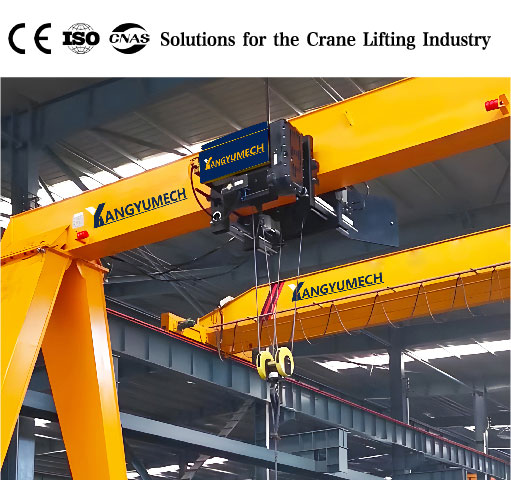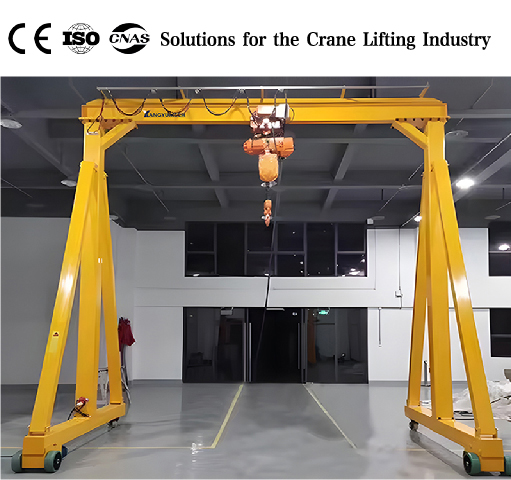
In factories, warehouses, and small-scale construction sites where every square meter of space counts, traditional gantry cranes often fall short—their external suspension (overhanging beams beyond the support legs) can collide with walls, racks, or equipment, limiting operational flexibility. This is where no external suspension single girder gantry cranes shine. Designed with a compact structure that eliminates unnecessary overhangs, this crane type delivers reliable lifting performance (typically 1-10 tons) while fitting seamlessly into tight workspaces. Whether you’re a facility manager struggling with space constraints or a business owner seeking a cost-effective, low-maintenance lifting solution, this guide will break down everything you need to know about no external suspension single girder gantry cranes: their design, key benefits, applications, tips, and how they outperform traditional models.

What Are No External Suspension Single Girder Gantry Cranes?
To understand this crane type, let’s start with its core definition and structural differences from standard single girder gantry cranes:
1. Core Design: No Overhang, Maximum Space Efficiency
A single-girder gantry crane with no external suspension features a single main beam (girder) supported by two end carriages (legs), with no part of the girder or lifting mechanism extending beyond the outer edges of the legs. Unlike traditional single girder gantry cranes—whose girders often overhang 1-2 meters to expand coverage—this design keeps the entire crane within a fixed “footprint,” making it ideal for areas where side clearance is limited (e.g., warehouses with narrow aisles or factories adjacent to production lines).
The main beam is typically made of high-strength I-steel or box-section steel (Q235/Q345 grade), striking a balance between rigidity and lightweight performance. The lifting mechanism (usually an electric hoist or chain hoist) runs along the bottom of the girder, with no external components protruding—further reducing the risk of collisions with surrounding objects.
2. Key Structural Components
Every no external suspension single girder gantry crane relies on four essential parts to ensure safe, efficient operation:
- Main Girder: The horizontal beam that bears the load; its length (span) ranges from 5m to 20m, matching most small-to-medium workspace dimensions.
- End Carriages (Legs): Heavy-duty steel frames with wheels that run along ground rails (or rubber tires for rail-free models); they support the girder and enable the crane to move forward/backward.
- Lifting Hoist: An electric or manual hoist attached to a trolley that travels along the girder; electric hoists (220V/380V) are preferred for frequent use, offering lifting speeds of 8-15 m/min.
- Control System: Includes a pendant controller or wireless remote to operate lifting, trolley travel, and crane movement—with emergency stop buttons and limit switches for safety.
Key Advantages of No External Suspension Single Girder Gantry Cranes
The “no external suspension” design isn’t just a structural choice—it solves critical pain points for businesses operating in confined spaces. Here’s why this crane type is gaining popularity:
1. Unmatched Space Efficiency
For workspaces where width or side clearance is limited (e.g., a 10m-wide warehouse with 2m-wide storage racks on both sides), traditional gantry cranes with external suspension would struggle to move without hitting racks. A no external suspension model, however, fits perfectly within the available span: its legs align with the workspace edges, and the girder stays within the leg width, eliminating collision risks.
In practice, this design can save up to 30% of lateral space compared to traditional single girder gantry cranes. For example, a warehouse with a 12m span can use a no external suspension crane with 10m girder length (matching the usable space) instead of a traditional 12m girder with 1m overhangs on each side.
2. Enhanced Structural Stability
External suspension adds extra stress to a crane’s main girder—over time, the overhanging sections can bend or warp under repeated loads, reducing lifespan. No external suspension models distribute weight evenly across the girder and legs, minimizing stress concentration. Tests show that these cranes have a 20-25% longer service life (10-15 years) compared to traditional models with similar load capacities.
Additionally, the compact design reduces wind resistance—making them safer for semi-outdoor use (e.g., covered loading docks) where light winds (≤8 m/s) are common.
3. Lower Installation & Maintenance Costs
Traditional gantry cranes require extra rail extensions or structural modifications to accommodate external suspension, increasing installation time and cost. No external suspension single girder gantry cranes, by contrast:
- Need only a simple ground rail system (or no rails at all for rubber-tired models) that aligns with the crane’s footprint.
- Can be installed in 1-3 days by a 2-3 person team, compared to 3-5 days for traditional models.
Maintenance costs are also lower: with no overhanging components, there are fewer parts prone to wear (e.g., no extra trolley wheels for overhangs). Annual maintenance typically costs
400, 30% less than traditional single girder gantry cranes.
4. Flexible Operation for Confined Tasks
The absence of external suspension doesn’t limit lifting coverage—instead, it optimizes it for tight spaces. For example:
- In a machine shop with rows of CNC equipment, the crane can move between workstations without scraping against machine enclosures.
- In a food warehouse with tall storage racks, the crane’s precise trolley movement (error margin ≤5cm) ensures loads are placed exactly on rack shelves, avoiding damage to inventory.
Many models also offer 0-90° steering for rubber-tired versions, allowing them to navigate around fixed obstacles (e.g., pillars or loading docks) with ease.
Real-World Applications of No External Suspension Single Girder Gantry Cranes
The “space-saving + reliable” combination makes this crane type a top choice for multiple industries. Below are three common use cases:
Case 1: Small-Scale Manufacturing Workshop
A metal fabrication workshop in Ohio (U.S.) with a 15m × 8m floor space needed a crane to lift steel plates (up to 5 tons) between cutting and welding stations. Traditional gantry cranes with external suspension would have blocked the workshop’s only exit (located along one wall). By installing a 5-ton no external suspension single girder gantry crane (span 12m), the workshop achieved:
- 100% utilization of floor space (no need to move racks or equipment).
- A 40% reduction in lifting time (from 20 minutes to 12 minutes per plate).
- Zero collision incidents in 2 years of operation.
Case 2: Pharmaceutical Warehouse
A pharmaceutical warehouse in Germany stores temperature-sensitive drugs on racks placed 1m from the walls. Using a traditional crane was risky—external suspension could damage racking or compromise drug packaging. A 3-ton no external suspension model with a wireless remote allowed operators to:
- Lift pallets (weighing 1.5-2.5 tons) directly from delivery trucks to racks.
- Maintain compliance with EU GMP (Good Manufacturing Practice) standards (no risk of product damage).
- Increase daily throughput by 20% (faster, safer load handling).
Case 3: Solar Panel Assembly Plant
A Chinese solar panel manufacturer needed a crane to move glass substrates (2m × 1.6m, weighing 800kg) between assembly lines. The plant’s narrow aisles (only 3m wide) ruled out traditional cranes. A 1-ton no external suspension single girder gantry crane with a custom anti-sway hoist:
- Prevented substrate breakage (a $500 loss per unit) with precise positioning.
- Fitted within the 3m aisle width, eliminating the need for facility expansion.
- Reduced labor costs by 15% (one operator could handle lifting tasks instead of two).
How to Choose the Right No External Suspension Single Girder Gantry Crane
To select a model that fits your workspace and lifting needs, follow these 5 steps:
Step 1: Define Load & Span Requirements
- Maximum Load Capacity: Choose a crane rated for 10-20% more than your heaviest regular load (e.g., if you lift 4-ton parts, select a 5-ton crane).
- Span (Girder Length): Measure the distance between your workspace’s two farthest support points (e.g., walls or rack edges). Ensure the crane’s span matches this distance exactly—no external suspension means no extra coverage beyond the span.
- Lifting Height: Calculate the vertical distance from the floor to the highest lift point (e.g., top of a rack). Most models offer lifting heights of 3-8m; opt for a taller model if you need to stack loads.
Step 2: Match the Crane to Your Workspace
- Indoor vs. Semi-Outdoor: For indoor use (e.g., warehouses), choose a standard model with IP54 protection (dust/water resistance). For semi-outdoor use (e.g., covered yards), select a galvanized steel model with IP65 hoist to resist corrosion.
- Rail vs. Rail-Free: Rail-mounted models are better for fixed paths (e.g., between two production lines). Rubber-tired models (with battery power) suit flexible paths (e.g., warehouses with changing rack layouts).
Step 3: Select the Right Lifting Hoist
- Electric Hoist: Ideal for frequent lifting (5+ times/day) or heavy loads (3-10 tons). Choose 220V for small workshops or 380V for industrial sites.
- Manual Hoist: Suitable for occasional use (1-2 times/day) or areas without electricity. Note: Manual hoists have slower lifting speeds (2-3 m/min) and require more operator effort.
Step 4: Prioritize Safety & Compliance
Ensure the crane meets international standards to avoid accidents and legal risks:
- Safety Features: Look for overload protection (stops lifting if load exceeds rating), limit switches (prevents overtravel), and emergency stop buttons.
- Certifications: For global markets, confirm CE (Europe), OSHA (U.S.), or ISO 4301 (international crane safety) compliance. For China, check GB/T standards.
Step 5: Compare Manufacturers & After-Sales Support
Not all no external suspension cranes are built equally. Focus on brands with expertise in compact lifting solutions, such as:
- Yangyu: Offers custom span options (5-20m) and 2-year warranties on main components.
- Konecranes: Specializes in high-precision models for manufacturing.
- Demag: Known for durable rail-free rubber-tired versions.
Read customer reviews to assess reliability, and choose manufacturers that provide local maintenance support (e.g., 24-hour repair service) to minimize downtime.
Installation & Maintenance Tips for Long-Term Performance
Proper installation and regular maintenance are key to maximizing the lifespan of your no external suspension single girder gantry crane:
Installation Best Practices
- Ground Preparation: For rail-mounted models, install steel rails (≥20mm thick) on a level concrete foundation (≥15cm thick). Use a laser level to ensure rails are aligned (error ≤1mm/m) to prevent uneven wear on wheels.
- Girder Alignment: Lift the main girder onto the end carriages and secure it with high-torque bolts (300-400 N·m). Check that the girder is horizontal (no more than 0.5mm/m slope) to avoid load tilting.
- Test Run: After installation, conduct:
- A no-load test: Move the crane forward/backward and run the trolley along the girder to check for smooth operation.
- A 100% load test: Lift your maximum rated load and hold it for 10 minutes to confirm stability.
Maintenance Schedule
Frequency | Tasks to Perform |
Weekly | – Inspect hoist cables for fraying or kinks.- Check trolley wheels for wear.- Test emergency stop button and limit switches. |
Monthly | – Lubricate girder rails and trolley bearings with lithium grease.- Tighten loose bolts on end carriages.- Check hoist brake performance (adjust if load slips). |
Annually | – Hire a certified technician to inspect girder welds for cracks.- Replace worn parts (e.g., cables, wheels, or hoist motors).- Recalibrate overload protection systems. |
Common FAQs About No External Suspension Single Girder Gantry Cranes
Q1: Can this crane handle loads heavier than 10 tons?
A: Most standard models are rated for 1-10 tons, but manufacturers like Yangyu offer custom 12-15 ton versions for heavy-duty needs. Note: Heavier loads require thicker girders (≥20mm steel) and reinforced end carriages.
Q2: Is it possible to extend the span of an existing no external suspension crane?
A: No—since the design relies on a fixed span with no overhang, extending the girder would require replacing the entire main beam and end carriages. It’s more cost-effective to purchase a new crane with the correct span.
Q3: How does this crane compare to a jib crane in terms of space?
A: Jib cranes have a circular coverage area (limited by the jib length), while no external suspension single girder gantry cranes have a rectangular coverage area (span × travel distance). For long, narrow spaces (e.g., 20m × 5m warehouses), gantry cranes are more efficient. For small, localized lifting (e.g., a single workstation), jib cranes may be better.
Conclusion
No external suspension single girder gantry cranes are a game-changer for businesses struggling with space constraints. Their compact design eliminates collision risks, enhances stability, and reduces costs—all while delivering the lifting performance needed for manufacturing, warehousing, and small-scale construction. By following this guide to define your needs, select the right model, and maintain it properly, you’ll invest in a crane that optimizes your workspace, boosts productivity, and stands the test of time.
If you’re ready to upgrade your lifting solution, start by measuring your workspace span and maximum load, then reach out to trusted manufacturers for custom quotes. With the right no external suspension single girder gantry crane, you’ll turn confined spaces into efficient, safe, and productive work areas.