
A wire rope electric hoist is the lifting heart of most industrial cranes. It grips the load, pulls it up, holds it steady, and lowers it back down — day in, day out, often hundreds of cycles per shift. Whether bolted to a bridge crane trolley, suspended from a jib arm, or mounted on a gantry crane, the hoist does the heavy lifting.
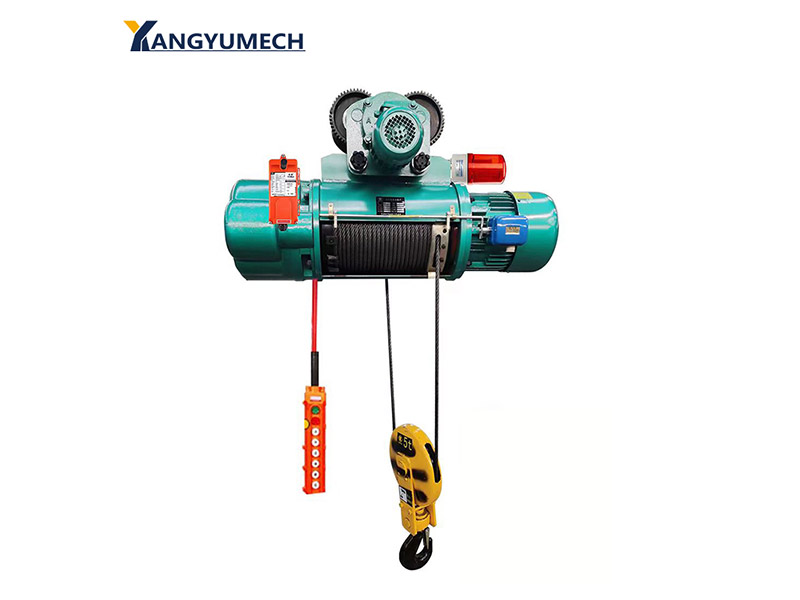
Every electric wire rope hoist shares the same basic architecture, though execution varies between manufacturers.
The lifting motor is a three-phase asynchronous motor — squirrel-cage for standard duty or slip-ring for heavy-duty applications with frequent starts. It drives the gearbox, which reduces motor speed and multiplies torque. The gearbox is helical or planetary; planetary is more compact and common in modern European-style hoists.
The wire rope drum is the grooved steel cylinder that the rope spools onto. Proper grooving ensures clean spooling under load. The rope itself is critical: most industrial hoists use 6×37 or 6×19 construction with an independent wire rope core (IWRC). Rope diameter, drum diameter, and the number of rope falls (single, double, or four) together determine rated capacity and wire rope electric hoist lifting speed.
The hook block sits at the dead end of the rope. It carries a forged alloy steel hook, a thrust bearing that lets the hook rotate under load, and a safety latch. A multi-fall hook block includes a sheave assembly for reeving.
The electromagnetic brake is the safety-critical element. Most modern hoists use a disc brake that engages automatically when power is cut — fail-safe by design. The brake holds the full rated load stationary without creep.
Controls include a pendant with up/down buttons or a radio remote. The contactor panel manages direction and speed; modern variable-frequency drives (VFD) allow smooth acceleration and deceleration, reducing shock loading on the rope and gearbox.
The wire rope electric hoist working principle is straightforward. The motor receives power from the control panel and turns the gearbox input shaft. The gearbox reduces rotational speed and transmits torque to the drum. As the drum rotates, the wire rope winds onto the grooved surface, pulling the hook block upward. To lower the load, the motor reverses. The electromagnetic brake engages the moment power is removed, holding the load at any height.
The engineering details matter, though. Drum grooving must match rope diameter exactly — mismatched grooving causes rope overlap, bird-caging, and premature failure. The rope fleet angle must stay within 1.5 degrees to prevent abrasion against the drum flange. Multi-fall reeving doubles or quadruples mechanical advantage but adds sheave friction and reduces lifting speed proportionally.
Wire rope electric hoist applications cover nearly every industrial sector. Steel mills use heavy-duty hoists on charging cranes, ladle cranes, and coil handling cranes — capacities from 10 to 100 tons, often with metallurgical-duty motors rated for ambient temperatures above 60°C. Foundries and forge shops use heat-resistant hoists with insulated hook blocks.
Precast concrete plants rely on wire rope hoists for moving heavy molds and cured elements. Shipyards use them on traveling gantry cranes for hull section assembly. Power plants use maintenance hoists for turbine service. In general manufacturing, a wire rope electric hoist is the standard lifting device on workstation bridge cranes from 1 to 20 tons.
For light-duty work — tool handling, maintenance shops, occasional lifting under 5 tons — an electric chain hoist is often more economical. The wire rope hoist wins at higher capacities, faster lifting speeds, and heavier duty cycles.
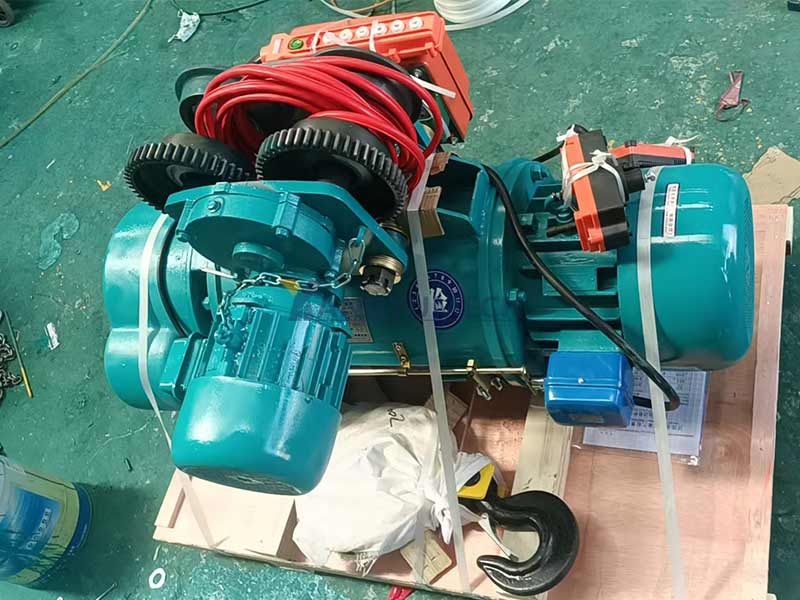
Wire rope electric hoist cost depends on capacity, wire rope electric hoist lift height, speed, duty class, and features. A 2-ton single-fall hoist with 6-meter lift, standard speed, and pendant control might run $800 to $2,000 from a Chinese manufacturer. A 10-ton double-fall hoist with 12-meter lift, VFD control, and FEM 2m FEM duty class moves into the $4,000 to $8,000 range. A 32-ton heavy-duty metallurgical hoist can exceed $15,000.
The wire rope electric hoist buying guide comes down to four questions. First, what FEM duty class do you need? FEM 1Am/2m suits light intermittent service; FEM 3m/4m handles continuous operation near rated capacity. Second, what lifting speed? Single-speed works for general handling; VFD variable-speed is necessary for precise positioning. Third, confirm rope diameter and drum construction match your lift height and capacity. Fourth, check the IP rating — IP54 for indoor general use, IP55 for dusty or humid environments, IP66 for outdoor or wash-down service.
If you are looking for a wire rope electric hoist for sale, always request the load test certificate. A reputable wire rope electric hoist manufacturer should test every unit to 125 percent of rated load before shipping, and provide the test report along with material certificates for the hook and rope.
Yangyumech is a wire rope electric hoist manufacturer building hoists from 1 to 50 tons, with lifting speeds from 3 to 12 m/min, lift heights up to 30 meters, and duty classes from FEM 1Am to FEM 4m. The product line includes single-fall and multi-fall configurations, European-style low-headroom designs, and heavy-duty metallurgical hoists with heat-resistant motors and insulated hook blocks.
Every Yangyumech wire rope electric hoist is built to FEM and ISO 4301 standards, load-tested to 125 percent at the factory, and shipped with complete documentation — inspection certificate, load test report, operation manual, and spare parts list. Yangyumech uses forged alloy steel hooks with safety latches, grooved drums matched to rope diameter, fail-safe electromagnetic disc brakes, and sealed bearings throughout.
The Yangyumech engineering team works with buyers to match capacity, speed, lift height, duty class, and control type to the actual application. VFD control, radio remote, and explosion-proof configurations (Ex d IIB T4) are available for hazardous environments. Yangyumech handles export logistics, customs documentation, and commissioning support.

