
Walk into any modern factory hall in Germany or Benelux and the overhead lifting equipment looks different from what you might see in an older facility. The difference is not cosmetic — the European bridge crane, also called a European overhead travelling crane, prioritizes compact structure, low deadweight, and higher working speeds over the bulk-and-beam approach. When comparing single girder vs double girder bridge crane configurations, understanding what drives that difference is where a smart procurement decision starts.
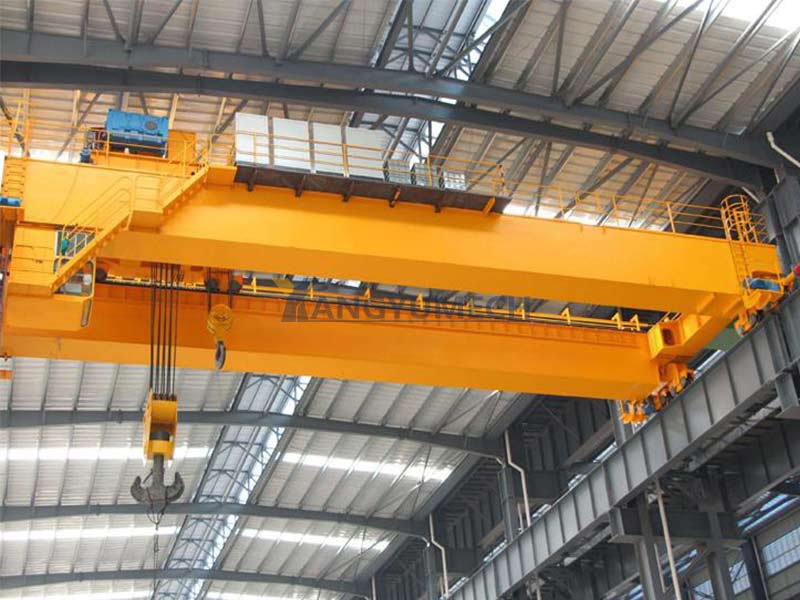
The european bridge crane components that define the system share a core set of structural and mechanical elements. What distinguishes the European approach is how each component is engineered for weight reduction and performance.
The european bridge crane girder spans the width of the bay, carrying the hoist and trolley. These girders are fabricated from high-strength box-section steel, designed with FEM calculation methods to minimize self-weight while maintaining stiffness. A lighter girder transfers less load to the building columns, often reducing civil engineering costs.
The end carriages sit at either end of the bridge girder and carry the bridge drive wheels. European bridge crane end carriages are typically machined as a single rigid unit rather than assembled from separate plates, which improves wheel alignment and reduces skewing during bridge travel. Many european bridge crane designs integrate the drive motor directly into the end carriage, eliminating the need for a separate gearbox and coupling arrangement.
The hoist and trolley assembly is equally distinctive. European electric wire rope hoists use an FEM-rated drum and gearbox arranged coaxially or in parallel, with the entire hoist mounted inside the trolley frame rather than on top of it. This is why a european bridge crane achieves lower headroom than traditional designs: the european bridge crane hoist sits inside the frame rather than on top of it.
On the electrical side, European configurations use variable frequency drives as standard on all motions, with soft-start and soft-stop ramps reducing mechanical stress. Radio remote control is typical, with a pendant backup. Limit switches, overload protection, and emergency stops wire into a single integrated control panel.
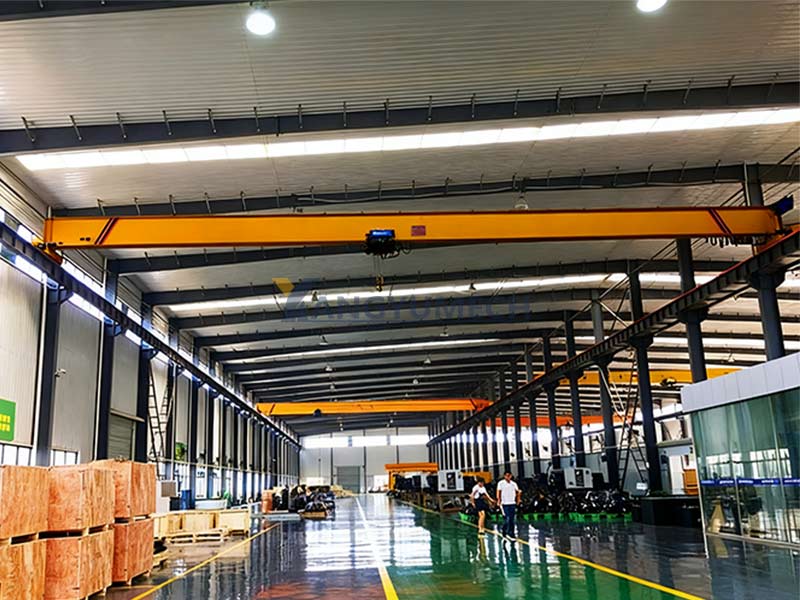
The european bridge crane single vs double girder choice sounds like it should be about capacity, and partly it is. The functional differences between a european single girder bridge crane and a european double girder bridge crane go deeper than that.
A european single girder bridge crane runs the hoist and trolley on the bottom flange of a single beam. This configuration is lighter, simpler to install, and the typical european bridge crane capacity for single girder designs runs from 1 to 20 tons with spans of up to 35 meters. The hoist travels beneath the girder, which means the hook approaches the building columns more closely — giving better coverage at the edges of the bay. For standard manufacturing workshops, assembly lines, and warehouse lifting, a single girder system is usually the economical choice that still delivers European performance standards.
A european double girder bridge crane mounts the trolley on rails welded to the top of two parallel girders. This configuration unlocks two practical advantages that single girder designs cannot match. First, because the hoist sits between the girders, the total headroom — from the building ceiling to the hook — is actually lower than a single girder of equivalent capacity, even though two beams are involved. This makes double girder cranes the preferred choice for facilities where ceiling clearance is tight and every millimeter of hook height matters.
Second, it handles heavy-duty applications beyond 20 tons up to 500 tons, with longer spans and duty classes up to M7. Steel mills, shipyards, and heavy fabrication halls routinely specify european double girder bridge cranes because the dual-beam structure handles load distribution and fatigue cycles a single beam cannot sustain over decades.
The trade-off is cost. A double girder european bridge crane price will be higher, not just for the extra structural steel but also for the more complex runway system, installation labor, and the deeper runway beams that the building structure must accommodate. The specification decision ultimately rests on three variables: required lifting capacity, available headroom, and duty cycle.
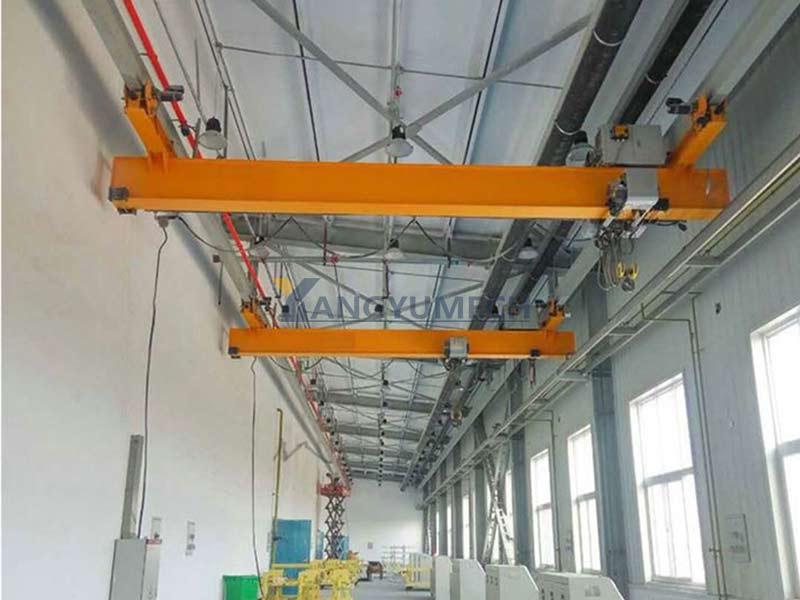
Beyond the girder choice, other factors drive the final european bridge crane specifications. The european bridge crane duty classification per FEM or ISO — FEM 1Am to 4m for manufacturing, higher for heavy industry — determines motor sizing and fatigue life. Full european crane specifications should be matched to actual operating conditions. Span must align with the building column layout; European designs offer tighter runway alignment tolerances. Lifting speed options, particularly variable frequency, affect both throughput and positioning precision.
Yangyumech is a professional european bridge crane manufacturer supplying single girder and double girder overhead crane systems to industrial clients across manufacturing, logistics, steel processing, and heavy engineering sectors.
Every Yangyumech european bridge crane is designed to FEM standards, fabricated from high-grade structural steel, and undergoes full load testing at the factory before shipment. Documentation packages include inspection certificates, as-built wiring diagrams, and full operation manuals. The engineering team works directly with procurement managers and plant engineers to configure the correct european bridge crane specifications — capacity, span, lift height, duty class, and control options — for the specific application.
As a european bridge crane manufacturer China-based, Yangyumech delivers competitive european bridge crane pricing with transparent configuration support and established export logistics to ports worldwide. Whether you are evaluating a european single girder bridge crane for a general assembly workshop or a european double girder bridge crane for a heavy fabrication bay, the team provides CIF and FOB quotations with detailed technical proposals.

