
In heavy industry, logistics and warehousing, and large-scale infrastructure sites, gantry girder cranes are like giant steel arms, carrying the heavy responsibility of moving mountains and seas. With its unique gantry frame structure and strong carrying capacity, this type of crane has become an indispensable piece of equipment in outdoor cargo yards, ports, and large-scale factories.
However, did you know that seemingly similar gantry girder cranes can actually be categorized into numerous distinct types based on their structural designs, application scenarios, and technical requirements? Choosing the right model is directly related to the project’s efficiency, safety, and cost.
This is the iconic equipment of the port and railway container transit station. It adopts a sturdy box-shaped double-beam structure, and the legs on both sides are usually rigid and soft (or both are rigid), and it walks accurately along the track laid on the ground.
Its core application is efficient stacking and handling of standard containers (20 feet, 40 feet, etc.). Due to its busy operations and large load impact, the carrying capacity of such cranes is usually from 40 tons to more than 100 tons, with a large span and excellent torsional and wind resistance stability. It is designed to cope with high-intensity and standardized logistics operations.
Unlike the orbital type, RTG crane relies on large pneumatic tires to move freely in the yard, with flexible steering and no fixed track investment. It is also the main force of container depots, especially suitable for occasions where frequent changes in operating channels are required.
Its carrying capacity is comparable to that of the orbital type, but mobility is its biggest advantage. Modern RTG uses more electric drive (diesel generator sets or lithium battery power supply) to develop in the direction of green and efficient.
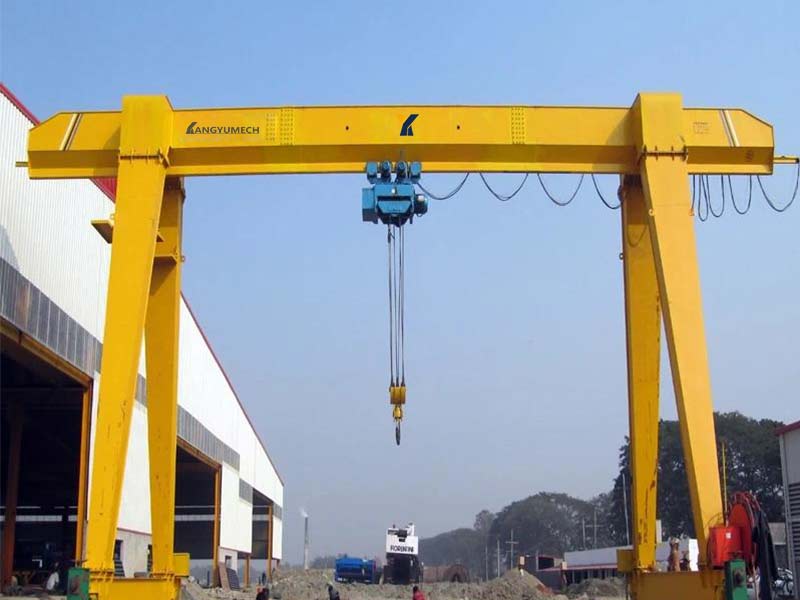
This is the most widely used category, and it is commonly used in open-air yards, power stations, shipyards, and construction sites. Structurally, it can be divided into a single main beam and a double main beam. The single main beam has a simple structure, light weight, and low cost, and is suitable for hoisting operations with a medium span of less than 20 tons.
The double main beam (box type or truss type) has stronger rigidity and good stability, and is suitable for lifting heavy materials with large tonnage (up to hundreds of tons) and long spans, such as steel and prefabricated components.
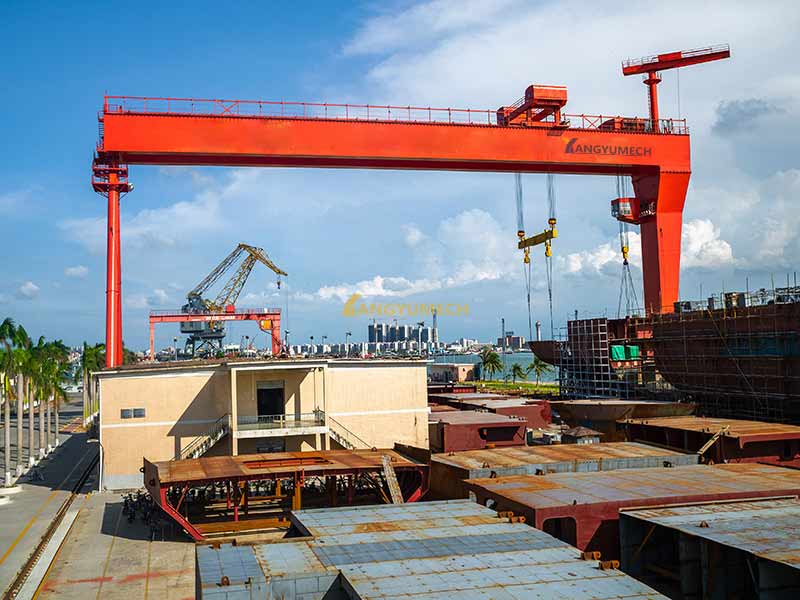
Specially built for shipbuilding and maintenance, it is a “big mac” in the field of cranes. It is characterized by extremely high lifting height (up to more than 100 meters) and extremely heavy lifting weight (from hundreds of tons to thousands of tons), and is usually equipped with more than two trolleys that can be operated jointly or separately to lift large hull segments. Its carrying capacity is the highest among all types, representing the pinnacle of heavy lifting technology.
The triangular truss structure is used as the main beam, which has lightweight, low wind resistance, and good economy. It is mostly used in situations where the lifting weight requirements are not high (usually below 10 tons), but a larger span is required, such as small and medium-sized warehouses, agricultural machinery repair stations, etc. Because of its open structure, it is easy to observe and maintain, and it is cost-effective in specific scenarios.
The carrying capacity of a gantry girder crane is not an isolated number, but is determined by a set of systems.:
Main beam structure: Double beams generally carry more load than single beams, and the torsional resistance of box beams is better than that of truss beams.
Lifting mechanism: the configuration level of motor power, reducer, wire rope, and hook group.
Outriggers and lower beams: responsible for transmitting all loads to the foundation, their stiffness and strength are essential.
Working level: According to the frequency of use and load rate (A1 to A8 levels), the design safety factor is different.
External environment: Natural factors such as wind pressure, snow load, and earthquake intensity will directly affect the design load.
Important note: The carrying capacity must be designed, manufactured, and certified in strict accordance with relevant national specifications (such as GB/T 3811), and the rated lifting weight must be marked in a prominent position; overloading is strictly prohibited.
Faced with such a variety of types and strict technical requirements, it is often difficult to choose a “standard” crane that fully fits the unique working conditions of the project. This is the value of professional customized services.
Yangyumech Crane Company, which has been deeply engaged in the industry for many years, is well versed in this way. We provide not only equipment, but also complete material handling solutions based on customer-specific needs.
Our team of engineers can communicate with you in depth, taking into account your material characteristics, operating frequency, site restrictions, budget, and construction period, and tailor the most suitable gantry girder crane for you. Whether it is:
Materials and processes that meet specific anti-corrosion, explosion-proof, or clean environment requirements.
Integrated automation control system to achieve precise positioning and intelligent scheduling
Turnkey service for the whole process from basic planning, installation, and commissioning to personnel training.
Yangyumech always insists on solid manufacturing technology, a rigorous quality control system, and safe and reliable products to escort the success of your project. We believe that the most suitable is the best.
Contact us immediately and let our experts provide a professional lifting solution consultation for your next project.

