
If you’ve walked a container terminal in the last eighteen months, you’ve probably noticed something: the cranes are getting bigger, faster, and—thankfully—a lot quieter.
The port crane market in 2026 is in the middle of a genuine shift, and it’s not just about moving more boxes. Between decarbonization pressure, larger vessels hitting the loops, and a shortage of skilled crane operators in some regions, terminal managers are rethinking what they actually need from their equipment.
Global demand for ship-to-shore cranes, RMGs, RTGs, and the associated automated guided vehicles is tracking at a compound annual growth rate somewhere around 4.5 to 5 percent through 2026.
That’s solid, but the real story is where the growth is coming from. Southeast Asia is building new terminals at a pace we haven’t seen in a decade—Vietnam’s Lai Vuoc, Indonesia’s new deepwater ports, the Philippines modernizing legacy facilities.
Then there’s Africa, where several countries are building their first real container terminals, often with Chinese financing and Chinese equipment.
China, unsurprisingly, continues to dominate both as a buyer and a manufacturer. What’s changing is the profile of what Chinese manufacturers are selling. It used to be that “Chinese crane” meant “cheap and basic.” That’s not the case anymore.
The leading Chinese suppliers—and we’re talking ZPMC, Sany, Weihua, and increasingly specialized manufacturers like Yangyumech—are delivering cranes with sophisticated automation interfaces, regenerative braking, and IoT-ready control systems.
They’re not just competing on price anymore; they’re competing on total cost of ownership over a twenty-year lifespan.
Talk to any port engineer in 2026 and three topics come up repeatedly.
First, automation. It’s not that everyone wants a fully automated terminal—those are still rare and expensive—but operators want cranes that are automation-ready.
The reason is practical: even if you’re not running remote operations today, you might need to in five years, and you don’t want to rip out and replace your crane control systems when that day comes.
Remote operation capability is rapidly becoming a standard specification on new STS crane orders, even for terminals that aren’t ready to deploy it fully.
Second, electrification and emissions. The old diesel RTGs are gradually being phased out, but the transition isn’t as simple as “swap to electric.” Some terminals don’t have grid capacity for full electrification, so hybrid solutions—diesel generator with battery buffer and regenerative braking—are the pragmatic middle ground.
Several crane manufacturers now offer retrofit packages that can cut fuel consumption by 30 to 40 percent. If you’re a port authority facing net-zero deadlines, that’s a conversation worth having.
Third, supply chain lead times. This one caught a lot of people off guard. Order a major STS crane today and you’re looking at 12 to 18 months delivery, sometimes longer if you want customized specifications.
For terminals that need to expand capacity quickly, that’s a problem. Some are turning to manufacturers that maintain semi-finished inventory or offer modular designs that can be assembled on-site, cutting delivery time by several months.
The global port crane manufacturer landscape in 2026 is still dominated by a familiar cast, but there’s movement.
ZPMC doesn’t really have competitors when it comes to volume. If you’re buying a large STS crane, there’s a good chance ZPMC is bidding. They’ve got the scale, the ship fleet to deliver assembled cranes, and increasingly sophisticated automation packages.
Konecranes and Liebherr hold the premium end of the market. If you’re operating in a high-wage region where crane downtime is catastrophically expensive, these are the brands you look at. The initial price is higher, but the maintenance costs and residual value calculations often favor them over a twenty-year horizon.
Then there’s the tier of aggressive Chinese manufacturers that are moving upmarket. Sany has made serious inroads internationally. Weihua and Henan Mine are strong in domestic Chinese projects and starting to win contracts in Southeast Asia and Africa.
And then there are specialized suppliers like Yangyumech, which have carved out a niche by being flexible on customization—something the big European brands sometimes struggle with—and offering direct-from-factory pricing that undercuts the major international brands without sacrificing on specifications.
For a terminal operator, this competitive landscape is actually good news. You have more options than you used to, and manufacturers are being forced to be more transparent about the total cost of ownership, not just upfront price.
If you’re specifying cranes this year, a few practical considerations are worth keeping in mind.
Don’t just model the purchase price. Model the energy consumption, the expected maintenance curve, the availability of spare parts in your region, and the residual value at the end of the crane’s life. A crane that costs 15 percent less upfront but costs 25 percent more to maintain over a decade is not the better deal.
Think about automation as a future-proofing exercise, not necessarily an immediate deployment. Specifying automation-ready drives, sensors, and control systems adds some cost upfront but protects you against having to do a major retrofit in five years.
And pay attention to after-sales support. This is where some of the lower-cost manufacturers have stumbled in the past—great equipment, but getting a spare part or a service technician to a remote port took weeks. The better Chinese manufacturers have learned this lesson and are building regional service hubs.
Yangyumech, for example, has been positioning itself as a supplier that doesn’t just sell you a crane and disappear; they provide installation supervision, operator training, and maintain a spare parts inventory for their delivered cranes.
For a port manager, that kind of support structure can be the difference between hitting availability targets and explaining to upper management why half your cranes are down.
Without turning this into a brochure, it’s worth understanding where a manufacturer like Yangyumech fits in the 2026 market. They’re not trying to out-ZPMC ZPMC on volume.
Instead, they focus on being a responsive, engineering-flexible supplier for terminals that need customized solutions—different lifting capacities, non-standard outreach, integration with specific terminal operating systems, or hybrid powertrain configurations for emissions compliance.
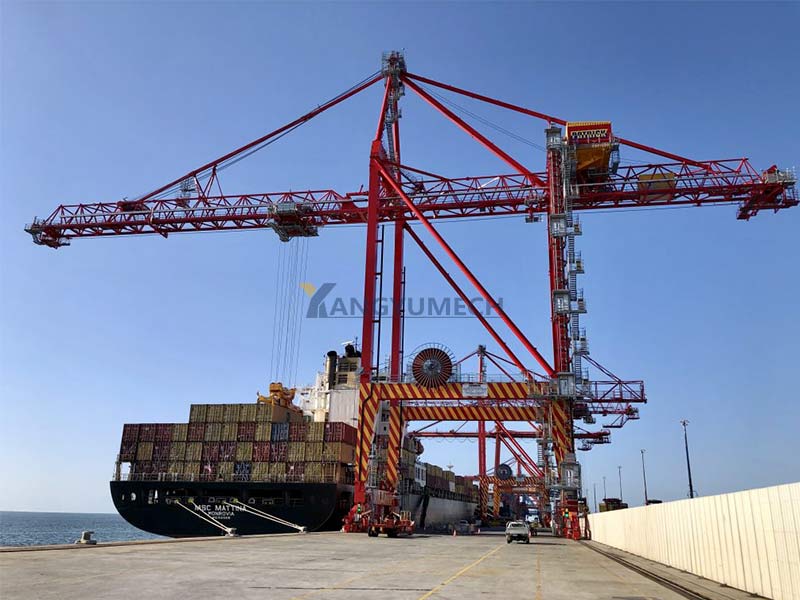
Their STS cranes handle up to 24,000 TEU vessels with lifting capacities up to 80 tons and outreach beyond 70 meters.
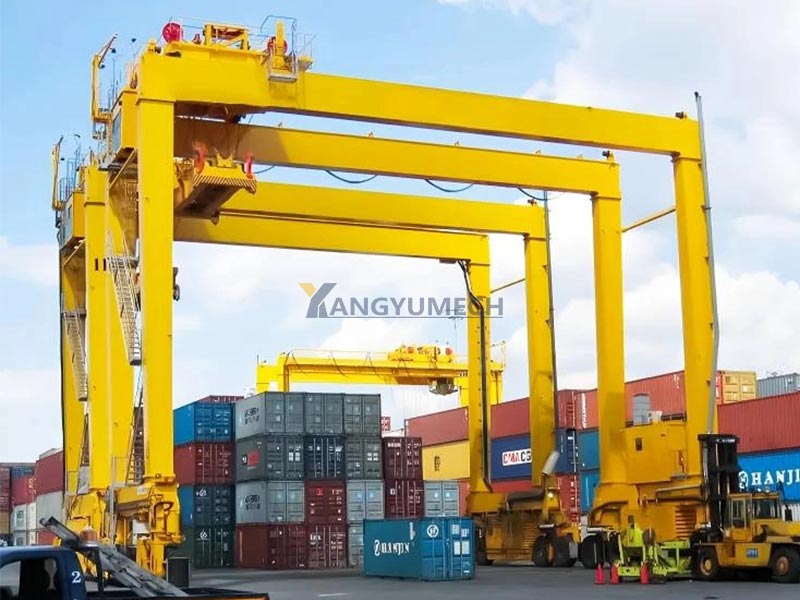
Their RMG cranes for container yards come with automated stacking algorithms and regenerative braking as standard or optional depending on specification.
RTG cranes are available in electric, hybrid, and traditional diesel configurations, with electrification retrofit kits available for existing fleets.
What’s genuinely useful for a terminal operator is the direct factory pricing model. By cutting out the distributor layer, Yangyumech can offer specifications that compete with the European premium brands at a price point that’s accessible to terminals that aren’t working with unlimited capital budgets.
If you’re in the process of specifying equipment for a greenfield terminal, modernizing an existing yard, or just trying to figure out whether electrifying your RTG fleet makes economic sense. It’s worth having a conversation with a supplier that can look at your specific operational profile rather than selling you a standard config sheet.
The port crane market in 2026 is competitive, rapidly evolving, and increasingly focused on total lifecycle value rather than just initial price. For terminal operators willing to look beyond the usual shortlist of suppliers, there are options that combine solid engineering with responsive service and realistic pricing. It’s a good time to be buying a crane—if you know what to look for.

