
A crane hoist is the lifting heart of any overhead handling system. The bridge, the trolley, the runway structure — all of it exists to position the hoist where it needs to go. But the hoist itself does the actual work of lifting, holding, and lowering the load. Specifying the right hoist for an application is not complicated when you understand the basic types, the duty classifications that define how hard a hoist can work, and the operating conditions that determine which features matter. Getting the specification right protects the investment and keeps the operation running without unplanned downtime.
A crane hoist is a lifting device that uses a drum or sprocket to raise and lower a load via wire rope or chain. The hoist includes the lifting medium, the motor that drives it, the gearing that converts motor speed to lifting speed, the brake that holds the load, and the hook or attachment that connects to the load. Most hoists mount on a trolley that travels horizontally along a bridge girder or monorail beam, though stationary hoists mounted to a fixed structure are also common.
The distinction between a hoist and a crane is straightforward. The hoist handles vertical motion. The crane structure — the bridge, the runway, the gantry legs — handles horizontal motion. In practice, most buyers specify the crane and hoist together as a complete system. Understanding the hoist options available within that system helps you evaluate proposals from different suppliers and avoid paying for more hoist than you need, or worse, underspecifying for a demanding application.
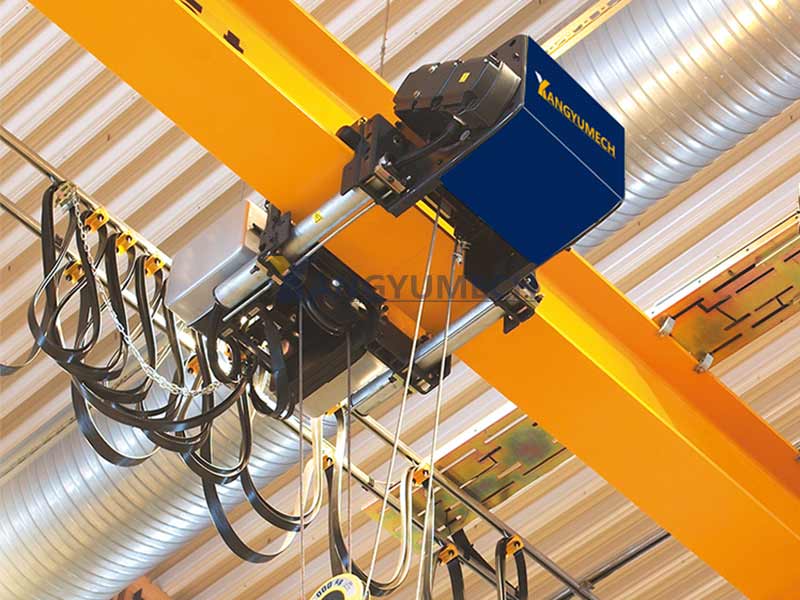
Wire rope hoists use a drum to wind and store multiple layers of wire rope. The rope passes over sheaves that route it to the hook block. Wire rope hoists are the standard choice for capacities above 10 tons and for lifting heights that require more rope storage than a chain can provide efficiently. The multiple layers of rope on the drum make wire rope hoists suitable for lifts of 20 meters, 30 meters, or more without increasing the physical size of the hoist body.
Chain hoists use a sprocket to lift load chain that runs through the hoist body and accumulates in a chain container or bag. For capacities up to about 10 tons, chain hoists offer a compact and cost-effective alternative to wire rope. The chain runs straight through the hoist without the fleet angle issues that affect rope on wide drums, which makes chain hoists well-suited to monorail systems with curves and switches. The tradeoff is that chain hoists become heavy and expensive at higher capacities, and the chain container grows with lift height.
European-style hoists represent a design approach rather than a specific product type. These hoists use low-headroom configurations, wire rope that exits the drum in a single layer for longer rope life, and modular construction that allows easy maintenance access. European-style wire rope hoists are now standard for most new overhead crane installations above 5 tons capacity because the design delivers better performance in the same or smaller envelope than older-style hoists.
CD and MD type hoists are the traditional wire rope hoist configuration used in industrial plants for decades. CD hoists have a single lifting speed. MD hoists add a slow speed for precise positioning. These hoists are straightforward, robust, and economical for applications that do not require the features or duty ratings of European-style designs. Many maintenance departments prefer CD and MD hoists because the design is simple to repair and parts are widely available.
FEM duty classification rates hoists according to how often they operate and how heavily they are loaded. A FEM 1Am hoist is designed for light occasional use, such as a maintenance shop making ten lifts per day. A FEM 4m or 5m hoist is built for continuous heavy-duty operation in steel mills, foundries, and high-throughput manufacturing where the hoist runs nearly constantly and frequently lifts near rated capacity.
The mistake many buyers make is selecting a hoist based on capacity alone without considering duty rating. A 10-ton hoist at FEM 1Am will fail quickly in a steel service center handling 80 lifts per shift. A 10-ton hoist at FEM 4m will cost more upfront but will run reliably for years in the same application. The duty rating determines motor sizing, gear quality, brake capacity, and the fatigue life of structural components.
Operating environment matters as much as duty rating. A hoist running in a clean, temperature-controlled warehouse faces different demands than one installed in a steel mill with heat, dust, and abrasive particles in the air. Explosion-proof hoists are required in environments with flammable gases, vapors, or dust. Stainless-steel hoists and food-grade lubricants are necessary for washdown and food processing applications. Outdoor hoists need weather protection, cold-weather lubricants, and sometimes heaters for the motor and control panel.
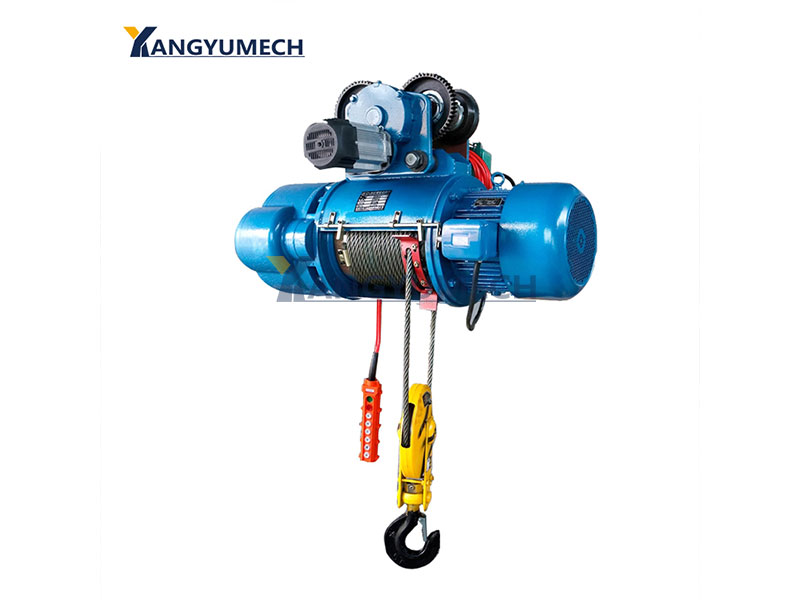
Wire rope hoists handle most general manufacturing, warehousing, and maintenance applications. Heavy industry uses high-duty-rated wire rope hoists for steel handling, coil handling, and continuous production line service. Chain hoists serve lighter-duty applications, workstations, and assembly areas where low headroom or monorail travel is required.
Explosion-proof hoists are mandatory in oil and gas facilities, chemical plants, paint shops, and grain handling operations where combustible dust or vapor is present. These hoists use sealed motor enclosures, spark-resistant materials on load-handling components, and intrinsically safe control circuits to prevent ignition sources.
Low-headroom hoists fit applications where the building height limits vertical clearance. The hoist body and trolley are configured to minimize the distance between the bottom of the runway beam and the hook, allowing maximum lift height in a tight building envelope.
Yangyumech manufactures crane hoists from 1 to 80 tons capacity across wire rope and chain configurations. European-style wire rope hoists are available from 1 to 80 tons with FEM duty ratings from 1Am to 5m, designed for continuous operation in heavy industrial environments. CD and MD type wire rope hoists cover 1 to 50 tons for standard industrial applications with proven reliability and straightforward maintenance.
European-style chain hoists from 1 to 12.5 tons serve workstation and light-duty applications where low headroom and compact dimensions matter. Explosion-proof hoists, stainless-steel hoists, and low-headroom configurations are available across the product range.
Every Yangyumech hoist ships with a test certificate, operation and maintenance manual, and a spare parts list. We supply hoists as standalone units or as part of complete overhead crane systems including bridge, trolley, runway, and electrical controls.
Direct factory pricing means you get a Yangyumech hoist at a competitive price without distributor markup. Standard models are in stock for fast shipment; custom configurations are quoted within 24 hours with detailed technical proposals. Our engineering team supports hoist selection, runway design, and installation planning at no additional cost.

