
Walk through any busy fabrication shop, steel yard, or assembly hall and you might spot a crane that looks like someone took a full gantry crane and cut it in half. One end rides on an elevated runway beam, often fixed to a wall or building column. The other end travels on a single leg rolling along a floor-level rail.
That is a semi-gantry crane, and it is one of the most underrated solutions in material handling. It isn’t trying to be a full-bay overhead crane. It does something smarter: it gives you precise, heavy-lifting coverage exactly where you need it, without the structural headache or the price tag of a complete bridge crane system.
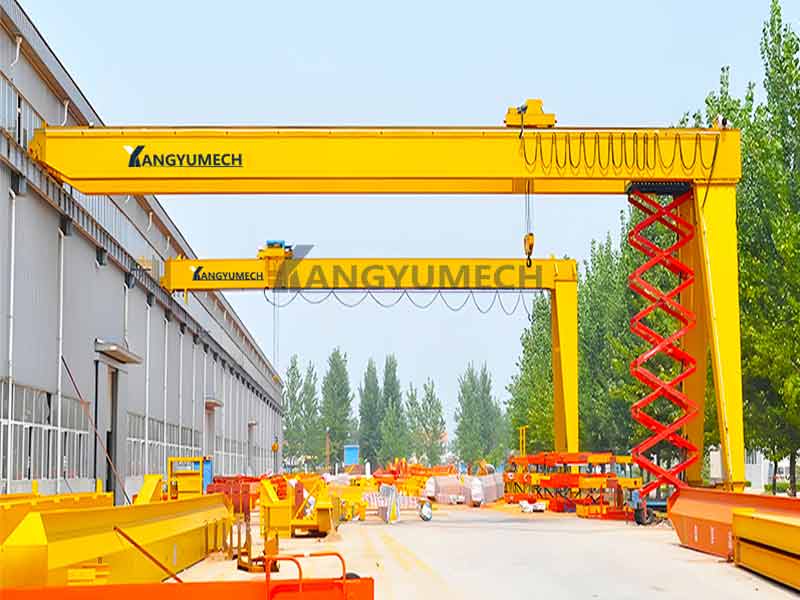
A semi-gantry crane design bridges two ideas. The inboard side uses an existing building column or a newly installed wall-mounted runway, while the outboard side uses a ground-supported leg.
Because only one side touches the floor, the crane needs significantly less steel than a double-leg gantry, and it places far less demand on the building’s roof structure than a full overhead crane.
You get a runway-style travel path, a hoist that traverses across the girder, and lifting coverage that follows the length of your runway while reaching across the width defined by your girder span.
Single girder semi gantry cranes typically serve capacities up to 20 tons, though heavier double girder variations exist for more demanding cycles. Adding a cantilever extension on one or both ends is common, which creates an outboard reach for loading from trucks or stacking material outside the direct rail span.
The main reason shops choose a semi-gantry crane system is building constraint. Not every facility has two parallel runway beams ready for a top-running bridge crane.
Roofs may be too weak, columns too sparse, or headroom too tight. Retrofitting a full overhead setup can cost more than the crane itself.
A semi-gantry crane avoids this entirely: one runway mounts to an existing wall or column line, the floor rail sits on a simple reinforced concrete foundation, and installation happens without major steel modifications to the building frame.
That alone can cut the total project cost by thirty to fifty percent compared to installing a new overhead crane with runway support steel.
Floor space is another factor. A semi-gantry crane for concrete floors keeps the area under the crane open for forklift traffic, welding stations, or material staging. There is no second leg obstructing the workspace.
Maintenance teams appreciate the accessible design too — hoists, traveling motors, and electrical panels sit at reachable heights rather than buried in a high roof structure.
For operations that need outdoor coverage, an outdoor semi-gantry crane with weatherized drives and corrosion protection can work reliably in a yard without the full enclosure a bridge crane would require.
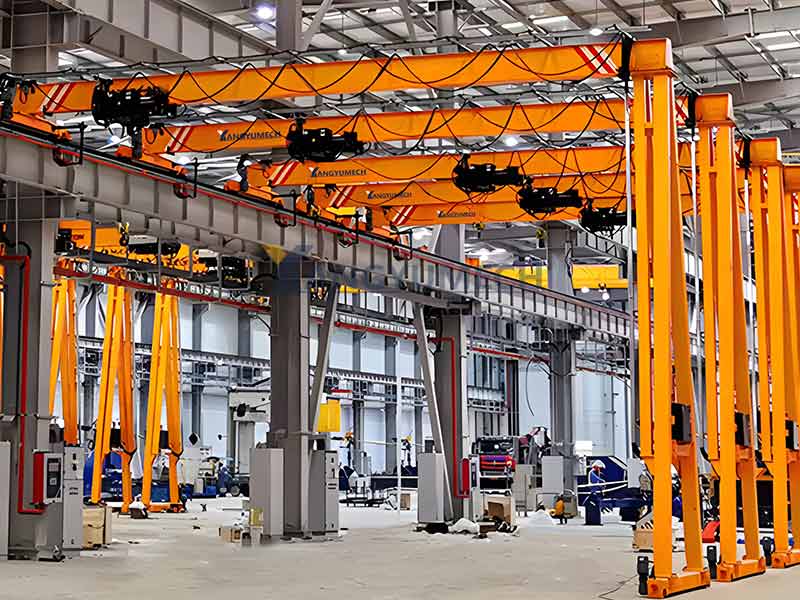
Semi-gantry cranes appear wherever there is a defined material flow along a wall or a row of machines. Steel service centers use them to move plate and profiles from incoming rail cars or flatbed trucks into cutting and sawing stations.
Assembly bays position a workshop semi gantry crane alongside a production line to feed heavy components from a staging lane directly to the assembly station. Precast concrete plants rely on them to rotate and position heavy forms without tying up the main yard crane.
Lumber mills and aluminum extrusion plants use semi-gantry setups to transfer long bundles from storage racks onto processing lines.
Even automotive component rebuild shops deploy light duty semi gantry crane units for engine and transmission staging. The consistent element is a fixed material path where a single wall or column line can serve as the high-side support.
When you move from concept to quotation, several parameters define the crane’s performance and price. Lifting capacity and service factor come first: a 5-ton semi gantry crane handling occasional maintenance lifts has a very different duty cycle and motor sizing from a 10-ton unit in a two-shift steel processing plant.
Girder choice—single girder versus double girder—affects hook height, weight, and overall cost. Single girder semi gantry crane configurations work well up to about 20 tons and moderate spans, while double girders enter the picture for higher capacities or spans exceeding 25 meters.
Cantilever overhang is a value multiplier: even a 3-meter overhang can dramatically increase effective coverage without lengthening the rail system. Variable frequency drives on hoist and travel motions reduce load swing and creep-speed positioning, which operators in assembly bays and mold change areas genuinely appreciate.
Don’t overlook the runway interface. The high-side rail may be a simple rolled beam bolted to a column, or an engineered runway with its own bracing. The floor rail needs a flat, reinforced concrete foundation to maintain alignment.
Electrical supply often runs via festoon cable systems or enclosed conductor bars depending on travel length and environment. For specifications, look for manufacturers that design to CMAA, FEM, or ISO standards and that test every hoist and drive assembly before shipping.
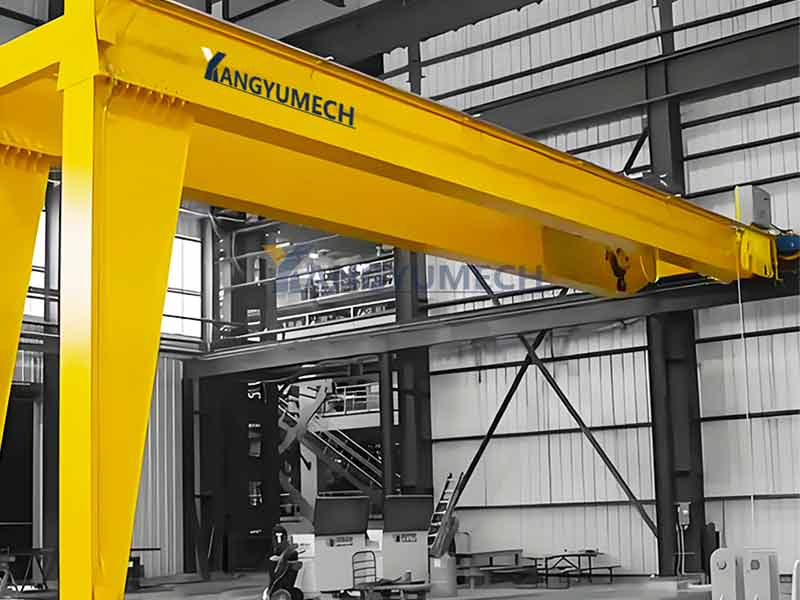
Henan Yangyumech Co., Ltd. builds semi-gantry cranes out of Changyuan, China’s hub of lifting equipment engineering. Our company has spent three decades refining manufacturing processes that balance structural robustness with cost efficiency.
Our single girder semi gantry cranes cover capacities from 2 to 20 tons, with spans, hook heights, and cantilever extensions tailored to your actual building dimensions and workflow. Every system incorporates premium structural steel, integrated overload protection, and standard variable frequency drives for smooth acceleration. Control options include pendant button stations and radio remote systems.
If your application calls for an outdoor semi gantry crane in a marine or high-humidity environment, Yangyumech engineers add appropriate anti-corrosion treatments and weather-rated components without one-off engineering chaos.
Where Yangyumech stands out for practical buyers is price honesty. Pre-engineered modular design keeps reference pricing for single girder semi gantry crane units in the range of 6,000 to 30,000 per set, depending on capacity, span, lift height, and duty classification.
Double girder configurations and heavy-duty A5–A7 class cranes sit higher, but the company’s direct-factory model avoids the layered margins common in distribution chains.
You get ISO 9001 quality, CE certification for applicable models, and a crane that ships fully load-tested and accompanied by complete documentation. Multiple-unit orders for workshop expansions or new facility builds realize additional savings through bundled engineering.
For a quotation tailored to your loading requirements, runway layout, and operating environment, reach the engineering sales team at www.yangyumech.com.
Mention your span, lift height, and whether a cantilever extension would improve your material flow—we’ll walk you through the options and deliver a specification sheet and pricing without high-pressure tactics.

