
Not every workshop has the clearance, the budget, or the structural support for a full overhead bridge crane. That is where the semi gantry crane (sometimes called a semi portal crane) earns its place. One side of the bridge runs on an elevated runway; the other rests on a ground-level rail. This hybrid design brings bridge-crane lifting performance into facilities where a standard overhead system simply will not fit.
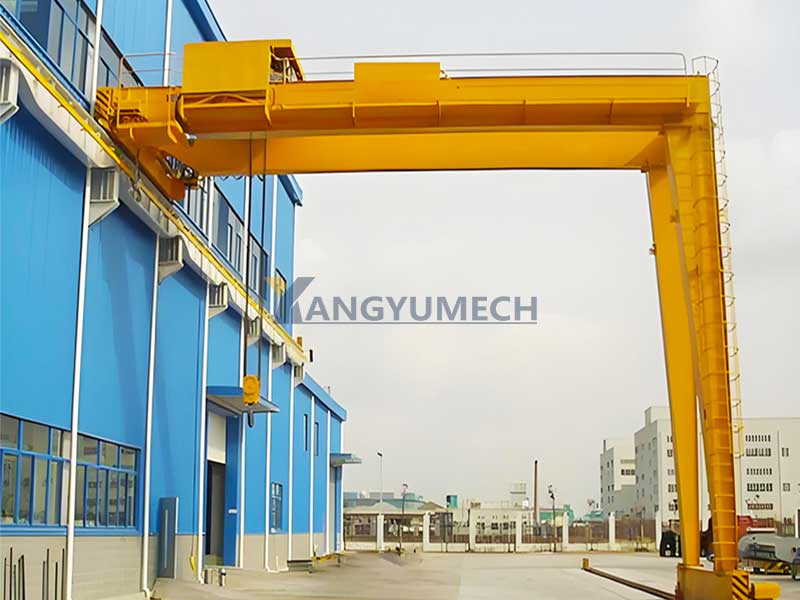
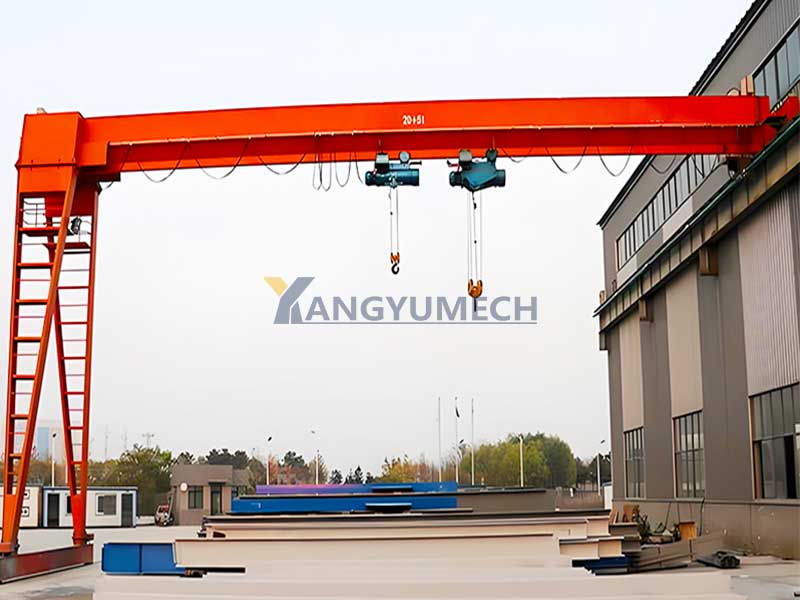
The single leg semi-gantry crane is a practical choice for manufacturing workshops handling machine tool loading, component assembly, and repetitive feed operations along linear production lines. The open design lets operators approach loads from multiple angles, which matters when working with large or awkwardly shaped workpieces.
In steel mills and metal fabrication yards, semi-gantry cranes manage hot-rolled coils, steel plates, and structural beams under demanding conditions. A double leg semi-gantry crane handles the heavier capacities typical in these environments — often well above 50 tons — with the stability needed for wide-span operations.
Outdoor storage yards represent another strong application. An outdoor semi-gantry crane works effectively alongside open storage areas, loading trucks, repositioning bulk cargo, and supporting stacking without requiring a full gantry structure over the entire yard. Precast concrete production also benefits from the rail-mounted approach, where the crane lifts and stacks heavy panels between casting beds.
Energy facilities — thermal plants, substations, and renewable energy sites — use industrial semi-gantry cranes for turbine component handling, transformer positioning, and maintenance lifting. These settings demand reliable, repeatable performance across varying load conditions.
The single leg configuration is the most compact option. One vertical support leg on one side, a trolley running on an elevated runway on the other. This minimizes floor space requirements and works well in narrow or irregularly shaped facilities, typically covering capacities up to approximately 20 tons and spans up to 15 meters.
The double leg semi-gantry crane distributes load across two support legs, offering greater stability and higher capacity. Standard double leg models handle spans from 10 meters to over 30 meters and lifting capacities ranging from 10 tons to 500 tons or more — making them the standard choice for heavy industrial and large outdoor applications.
Both types typically pair with an electric wire rope hoist or electric chain hoist, making an electric hoist semi-gantry crane configuration versatile across most applications, selected based on lifting capacity, lift height, and duty cycle. Rail-mounted travel distances can extend to 100 meters or beyond, making longer production lines feasible without compromising lifting performance.
When reviewing a semi-gantry crane for sale, these semi-gantry crane specifications are what most buyers focus on:
The semi-gantry crane capacity spans from 3 tons for light-duty models to 500 tons for heavy industrial configurations. Most standard models fall between 5 and 100 tons. Semi-gantry crane span — the distance between runway rails — typically ranges from 6 meters to over 30 meters. Lift heights commonly run from 6 meters to 24 meters, with custom configurations available. Duty class under FEM and ISO standards determines suitability for light, medium, or heavy operational cycles. Standard power supply is 380V / 50Hz three-phase, with 460V / 60Hz options for international buyers.
Comparing price quotes alone does not identify the right supplier. A credible semi-gantry crane manufacturer should offer custom engineering based on your facility layout, documented quality certifications such as CE, FEM, or ISO, and transparent documentation covering load tests, inspection reports, and warranty terms.
Export experience matters — look for manufacturers who understand international logistics, customs documentation, and on-site installation support. Lead times, after-sales service commitments, and spare parts availability all factor into the total cost of ownership.
Yangyumech is a professional manufacturer and exporter of industrial lifting equipment with years of experience producing single gantry cranes, double gantry cranes, and complete crane systems for clients worldwide.
Every Yangyumech semi-gantry crane is engineered to international standards, undergoes load testing before shipment, and ships with full documentation including inspection certificates and operating manuals. The team works directly with procurement managers and plant engineers to configure equipment that matches actual operating conditions — not just a catalog default.
Whether you need a compact single leg semi-gantry crane for a light assembly workshop or a heavy-capacity double leg system for a large outdoor yard, Yangyumech combines manufacturing flexibility with competitive semi-gantry crane price positioning for projects of any scale. Contact the sales team for detailed specifications, configuration recommendations, and CIF or FOB pricing tailored to your destination port.

