
If you move shipping containers for a living, you already know that the right handling equipment makes or breaks a terminal’s throughput. But if you are still working with older equipment or considering an upgrade, it is worth taking a step back and looking at what a container gantry crane actually does, where it is used most effectively, what types are available, and why so many operators specify one over alternative handling systems.
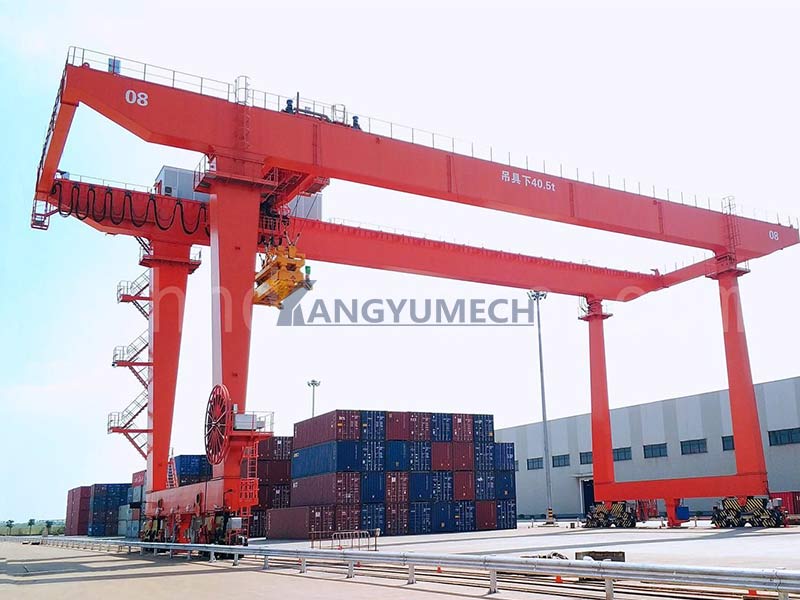
The container gantry crane applications span a much wider range than most people outside the logistics industry realise. Yes, ports and shipping terminals are the obvious home for these machines, but the uses of container gantry crane equipment also extend to rail freight hubs, intermodal yards, logistics distribution centres, and heavy industry facilities that receive or ship bulk cargo in container form.
In a shipping terminal, a container gantry crane for port operations is the backbone of the entire throughput cycle. The crane lifts containers from quayside vessels and stacks them in the yard, then retrieves them for loading onto trucks or rail wagons. Every minute saved per lift compounds across thousands of moves per day, which is why terminal operators are so particular about lift speed, span width, and stacking capability when specifying a new unit.
At a container gantry crane for terminal operation, the same principles apply: high stacking, fast cycle times, and reliable performance under continuous shift work. Rail-mounted units are the most common configuration at dedicated vessel berths because the fixed rail alignment allows higher speeds and heavier load ratings than mobile alternatives.
In a logistics hub or distribution centre, a container gantry crane for logistics work handles high-density stacking and yard transfers, where the stacking capability of a gantry crane outperforms reach stackers and forklift-based systems in both speed and land use.
In a rail freight terminal, a container gantry crane for rail operations handles the transfer of containers between trains and road vehicles or between rail tracks within the same yard. Rail-mounted gantry cranes are the most common configuration here because the fixed rail alignment matches the natural geometry of rail operations.
In heavy industry—mining, steel, and petrochemical facilities—a container gantry crane for shipping cargo handles inbound and outbound material flows that arrive in standard containers, particularly where port-adjacent infrastructure makes dedicated container handling equipment the most practical option.
The question of where to use container gantry crane equipment comes down to three factors: the volume of moves per day, the available land footprint, and whether the operation runs continuously. If all three factors are high, a gantry crane is almost always the right answer.
Understanding the types of container gantry cranes starts with recognising that “gantry” covers several distinct configurations, each suited to different site conditions.
A rubber tyred gantry crane—commonly called an RTG—runs on pneumatic tyres and is fully mobile within the yard without being confined to fixed rail tracks. The rubber tyred gantry crane is the most flexible option for terminals that need to reconfigure stacking blocks or move cranes between zones. Modern RTGs are diesel-powered or hybrid diesel-electric, with automated models available for high-volume operations.
A rail-mounted gantry crane sits on fixed rails running the length of the crane’s operating corridor, offering higher lifting speeds and heavier load ratings than RTGs because rail guidance eliminates the weight penalty of tyres and propulsion systems. Rail-mounted units are most common in dedicated vessel-loading berths and high-throughput automated terminals.
A mobile container gantry crane describes any self-propelled gantry unit that can travel between sites or operating zones without a crane-laying ceremony—larger than a typical RTG and capable of vessel loading as well as yard stacking.
An overhead container gantry crane operates under a fixed gantry frame with the hoist trolley running on top of the beams, most common in dedicated bays, rail terminals, and some automated facilities where precision between vehicles and stacking areas matters most.
The container gantry crane advantages come down to a few measurable factors that affect operational performance and total cost.
Stackability is the first. A gantry crane stacks containers four, five, or six high depending on the model, using the yard footprint far more efficiently than a reach stacker. For terminals with constrained land, that stacking capability is the difference between meeting throughput targets and running out of room.
Lift speed is the second. Modern container gantry crane specifications show lift speeds of 30 to 45 metres per minute under full load, with cycle times that allow a container to move from ship to stack in under two minutes at many operations—speeds that compound directly into throughput per berth per day. Beyond raw speed, the container gantry crane benefits include predictable, repeatable positioning that keeps the whole operation flowing from vessel discharge to yard stack to outbound vehicle.
Safety and precision are the third. Gantry cranes operate with spreader frames and automated landing systems that position containers with centimetre-level accuracy, reducing damage to containers and equipment compared to free-hand stacking. Container gantry crane safety systems—overload protection, anti-collision sensors, and travel limit switches—are standard on commercial models.
Footprint is the fourth. A single gantry crane covers a full stacking block and the lane beside it without entering the active stacking zone, reducing congestion and the risk of collision damage in busy terminals. For buyers comparing container gantry crane price against alternative systems, lower cost per lift over the machine’s service life is usually the decisive factor.
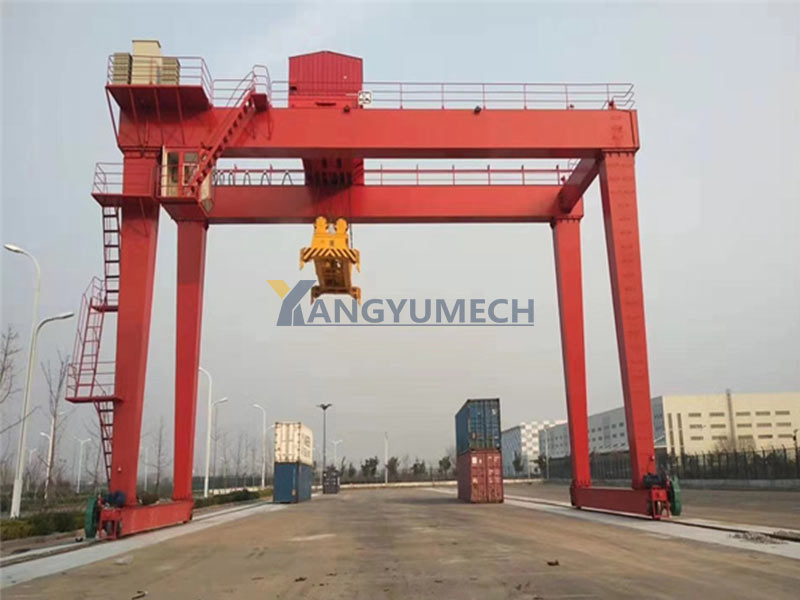
The container gantry crane manufacturer you work with shapes the whole ownership experience, not just the purchase transaction. A supplier that engineers its own structural steel and handling systems—rather than assembling third-party components—controls the quality of the critical load-path elements and can provide a single source of responsibility for the entire machine.
Working with an experienced container gantry crane supplier also means access to application engineering support during the specification stage: matching span width, lift height, stacking configuration, and power system to your actual site layout and throughput targets, rather than shipping a standard model that needs modification after installation.
Yangyumech is a lifting equipment manufacturer with a product range covering container gantry cranes, rubber tyred gantry cranes, overhead cranes, electric chain hoists, wire rope hoists, and aerial work platforms. The breadth of the range means Yangyumech supplies complete handling systems for ports, terminals, logistics hubs, and industrial facilities under a single specification and a single point of contact.
Every Yangyumech container gantry crane is load-tested and inspected before dispatch, with structural welding, electrical systems, and hydraulic components verified against documented quality procedures. The engineering team works from your site layout and operational data directly—matching span width, lift height, stacking configuration, and power source to your actual throughput targets and site constraints.
Yangyumech offers direct-to-end-user pricing that removes the distributor margin, which is how the same build quality reaches you at a more competitive container gantry crane price. A tailored quotation before you finalise the specification helps you avoid paying for span or lift height you will not use, and ensures the crane configuration matches your site’s actual operating conditions.

