
Choosing the right crane for a manufacturing facility is not a decision to take lightly. The wrong choice can mean wasted floor space, inefficient material flow, or a lifting system that struggles with the loads your operation actually handles. Over more than two decades supplying cranes to factories worldwide, we have seen what works and what does not.
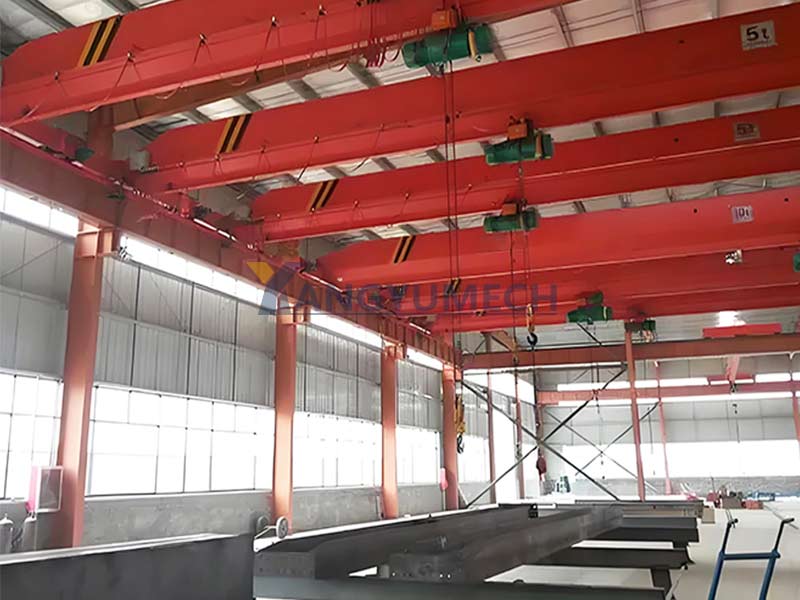
Walk through any serious manufacturing plant and you will likely find overhead bridge cranes doing the heavy work. These systems run on runway beams mounted to the building structure, with a bridge spanning the work area and a trolley carrying the hoist along that bridge. Simple in concept, but the execution determines whether you get years of reliable service or constant headaches.
Single girder bridge cranes use one main beam, with the hoist running on the lower flange. This keeps costs down for lighter applications, typically up to 20 tons, and reduces the structural requirements for your runway system. But there are tradeoffs. Lift height is limited by the hoist position, and you give up some rigidity compared to double girder designs.
Double girder bridge cranes put the hoist between two parallel beams. The hoist sits up between the girders rather than underneath, which buys you extra lift height—often critical in modern high-bay fabrication shops. More importantly, the twin girder construction handles the bending forces from heavy loads and long spans far better than single girder arrangements. If you are moving 30 tons or more, or spanning more than 25 meters, double girder overhead cranes for heavy manufacturing are not a luxury. They are a necessity.
The real advantage of overhead systems is what they do not take up. Floor space. A single 30-ton bridge crane with a 30-meter span and 80-meter runway coverage serves nearly 2400 square meters of production area while leaving the floor completely clear for forklifts, workstations, and personnel movement. For high-throughput operations like steel fabrication shops, heavy equipment assembly plants, and metal service centers, that floor efficiency translates directly to production capacity.
Not every facility can support overhead runway beams. Older buildings, outdoor storage yards, and operations where crane loads exceed practical building capacity all point toward gantry crane solutions. Here the bridge sits on legs that run along rails embedded in the floor, completely independent of the building structure.
Full gantry cranes with two supporting legs work well for outdoor material storage, precast concrete yards, and shipyard operations where weather exposure and heavy loads rule out roof-mounted systems. The floor-mounted rails do require proper foundation work, but you avoid the structural reinforcement that overhead runways might demand.
Semi-gantry or single-leg designs offer a middle path. One end of the bridge runs on an elevated runway while the other travels on floor rails. This configuration suits facilities that have runway support on one side only, perhaps from an existing overhead crane bay adjacent to an outdoor storage area.
For operations needing flexibility rather than fixed coverage, rubber tired gantry cranes eliminate rails entirely. The entire crane rides on pneumatic tires, able to travel anywhere within a yard or facility where the ground will support it. Steel distribution centers, pipe storage yards, and construction material depots often use mobile gantry cranes for manufacturing yards to handle loads in multiple locations without duplicating fixed crane infrastructure.
Full bay cranes are overkill for many workstation tasks. Loading a CNC machine, positioning a fixture on an assembly bench, or pulling a motor for maintenance does not require 30 tons of capacity or 20 meters of span. Jib cranes deliver focused lifting capability at individual work points without the cost and complexity of bay-wide systems.
Wall mounted jib cranes bolt to building columns, using the existing structure for support. No floor space for foundations, no runway beams to install. The jib arm rotates around the mast, typically 200 degrees for wall-mounted units, covering a circular work area. These work well for machine loading, assembly stations positioned along walls, and maintenance bays where floor space is tight.
Floor mounted jib cranes use a freestanding mast anchored to a foundation. This allows 360-degree rotation and placement anywhere the floor can support the load. When wall mounting is not possible, or when the jib needs to serve multiple adjacent stations, floor mounted designs provide the flexibility that wall units cannot.
Articulating jib cranes add a second pivot point in the arm. The outer section swings independently, letting operators reach around obstacles, into machine tool openings, or around corners. For precision positioning in congested work cells, workstation jib cranes with articulating arms often solve problems that straight-arm designs cannot touch.
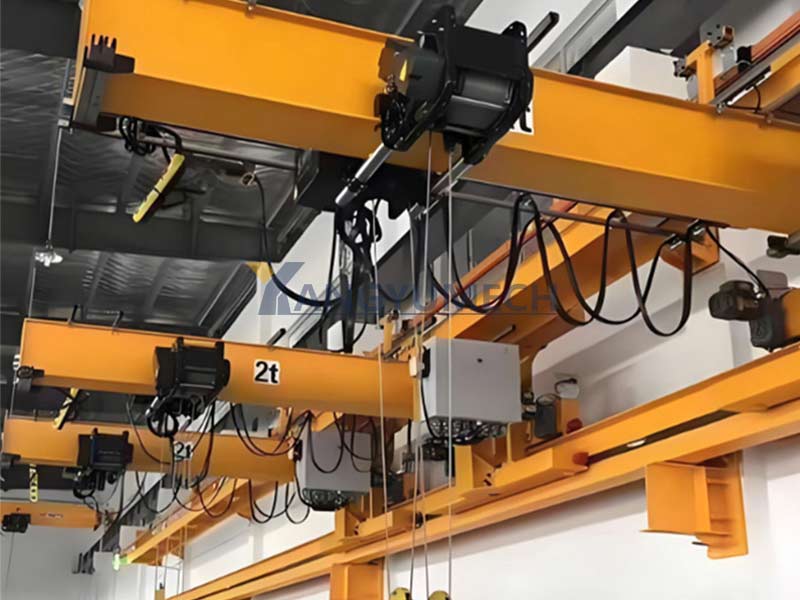
Some manufacturing processes follow a predictable sequence. Raw material enters at one point, moves through processing stations in order, and exits as finished product. Monorail cranes match this flow by routing loads along a fixed overhead track rather than covering an entire area.
The track can follow curves, incorporate switches for routing decisions, and include multiple levels for vertical movement between process stages. Hoists travel along this track, carrying loads between pickup and drop-off points without requiring operators to steer or position the crane. For high-volume production lines with consistent material routes, monorail cranes for assembly lines reduce handling time and eliminate the collision risks that come with free-ranging crane movement.
Automation integrates naturally with monorail systems. Motorized trolleys, programmable stops, and synchronization with production equipment all become straightforward when the load path is fixed. Paint lines, heat treatment sequences, and multi-stage assembly operations benefit from this controlled material flow.
The old model concentrated lifting capacity in central crane bays, with everything else moved by forklift or manual handling. Modern manufacturing takes a different approach, distributing lighter lifting capability throughout the facility to put material handling right at the point of use.
Aluminum workstation bridge cranes cover spans up to about 9 meters with capacities typically under 2 tons. Their light construction lets operators move the bridge and trolley with minimal effort, positioning loads precisely at assembly stations, packaging areas, or inspection benches. Enclosed track designs run smoothly and quietly, important in environments where noise or contamination are concerns.
Portable gantry cranes add mobility to workstation lifting. These units roll between work areas on casters, lock in place for lifting, and can be repositioned as production needs change. Maintenance shops, tool cribs, and temporary work stations all benefit from portable gantry cranes for industrial maintenance without committing to permanent installations.
Yangyumech has spent over 20 years building cranes for manufacturing operations worldwide. Our product range runs from 0.5-ton workstation jibs to 500-ton double girder bridge systems, with gantry cranes, monorails, and specialized configurations filling every gap in between. Every crane we ship meets FEM, ISO, and CMAA standards, with CE certification available for European and international markets.
We sell direct from our factory in Henan, China. No distributor markups, no middlemen adding cost to your project. Standard models ship with competitive lead times, and our engineering team designs custom configurations for operations that need something beyond the catalog. Whether you are equipping a small job shop with its first overhead crane or specifying a multi-crane system for a large fabrication facility, Yangyumech provides the equipment and the support to keep your operation running.
Pricing matters. We know that. Our direct sales model lets us offer heavy-duty manufacturing cranes at prices that compete with any source worldwide, without cutting corners on materials, engineering, or quality control. We back every crane with documentation, installation support, operator training, and spare parts availability through our global service network.
Ready to discuss your manufacturing crane requirements? Contact our sales team at sales@yangyumech.com or call +86-157-3677-5771. Please tell us what you need to lift, where you need to lift it, and we will provide a quotation that fits your operation and your budget.

